Italian authorities identify Roman shipwreck carrying hundreds of wine amphorae off Sicily
The wreck, dated to the 2nd and 1st centuries B.C., points to the scale of Mediterranean wine trade.
Friday, August 14, 2026
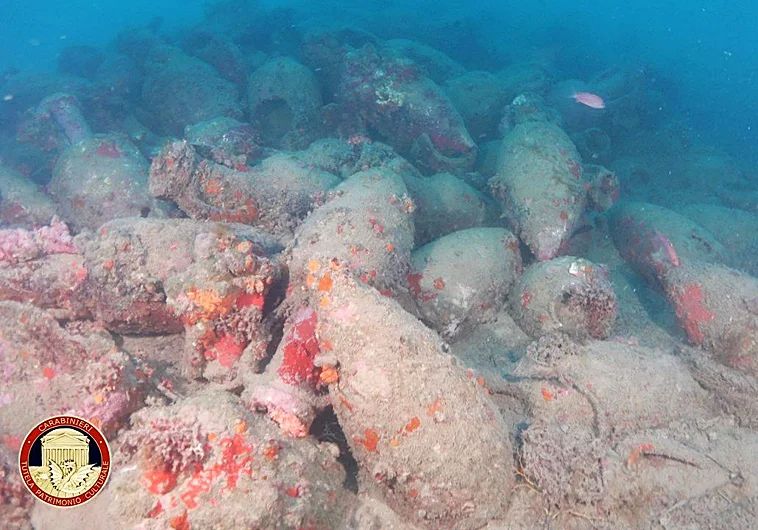
Italian authorities have identified a Roman shipwreck off the coast of Mazara del Vallo in southwestern Sicily, where hundreds of amphorae believed to have carried wine were found on the seabed 46 meters below the surface.
The discovery, announced this week, has drawn attention not only for its archaeological value but also for what it suggests about the scale of wine trade in the ancient Mediterranean before the birth of Christ. Initial estimates date the wreck to between the 2nd and 1st centuries B.C., according to Italian officials involved in the operation.
The site lies in the Strait of Sicily, a stretch of sea that has served as a commercial corridor for thousands of years. In antiquity, ships traveling between Sicily, Carthage, Spain and North Africa crossed these waters regularly, making the channel one of the most important maritime routes in the Mediterranean world.
Near the wreck, officials found a large concentration of Dressel 1A amphorae, a well-known Roman vessel type used mainly for transporting wine. These amphorae were large, cylindrical containers with pointed bases, designed to be packed closely together in a ship’s hold. Their presence at the site offers a direct link to the movement of wine across the sea at a time when the drink was already a widely traded commodity.
The find was made by the Carabinieri unit for the protection of cultural heritage in Palermo, the Sea Superintendency of the Sicilian Region, and the Carabinieri diving unit in Messina, with support from a Carabinieri patrol boat based in Trapani. Officials said the operation began after a report from private citizens.
In a statement released by the Ministry of Culture, Alessandro Giuli, Italy’s culture minister, called the wreck one of the most important underwater archaeological discoveries of recent years.
“It is one of the most important underwater archaeological discoveries of recent years,” Giuli said. “The sea continues to return precious fragments of our history, and the wreck of Mazara del Vallo speaks to us about the people, the routes and the exchanges that made the Mediterranean a crossroads of civilizations. Research will continue to reveal its history and return it to the public.”
For scholars of food and wine history, the find adds new evidence to a story that has long been reconstructed from written sources, amphora fragments and previous excavations. Wine was not a marginal product in the Roman world. It was consumed across social classes and traded in large quantities, often moving by ship over long distances. Cargoes of amphorae were a central part of that system, and their shapes and markings help archaeologists trace production areas, trade patterns and economic links between regions.
Dressel 1 amphorae in particular are closely associated with the expansion of Italian wine trade during the late Republican period. Their appearance at a wreck site off Sicily fits with what historians already know about the island’s role in Mediterranean exchange. Sicily sat between the Italian Peninsula, North Africa and the western Mediterranean, and its ports served as strategic points for ships carrying agricultural goods, including wine, grain and oil.
The discovery also touches on Sicily’s own long relationship with viticulture. The island’s wine history predates Roman rule, and scholars have often pointed to the influence of Greek settlers in shaping local vine growing and winemaking practices. Greek communities introduced grape varieties and technical knowledge that helped define the island’s agricultural identity long before the Roman period. The wreck therefore connects two related histories: Sicily as a producer of wine and Sicily as a maritime crossroads through which wine moved.
Officials have not yet released detailed information about the ship itself, including its construction, dimensions or state of preservation. At this stage, the amphorae are the clearest visible element of the site and the basis for the early dating. Further underwater work is expected to clarify the context of the wreck, its cargo and the route it may have been sailing when it sank.
The Sea Superintendency of the Sicilian Region is now expected to carry out additional documentation and study of the site. That work will aim to reconstruct the archaeological context and put in place protection measures. Underwater sites of this kind can be vulnerable to looting, fishing activity and environmental damage, especially once their location becomes known.
Mazara del Vallo, on Sicily’s southwest coast, has long faced the sea. Today it is known as a fishing port with deep ties to the Mediterranean, but the discovery offshore shows how far back that relationship extends. The wreck suggests a maritime world in which wine was already part of a broad commercial network that linked ports, peoples and economies across the basin.
For archaeologists, amphorae are often among the most useful objects recovered from ancient wrecks because they can reveal both cargo and chronology. Their forms changed over time, and certain types are closely tied to specific periods and regions. At Mazara del Vallo, the concentration of Dressel 1A vessels gives researchers an early framework for understanding the ship and its purpose, even before more extensive excavation begins.
Italian authorities said the next phase of work will focus on recording the site in detail and deepening the investigation. That process is likely to take time, especially at a depth that requires specialized diving and careful conservation planning. What has already emerged, however, is a vivid sign of how central wine was to ancient trade and how much of that history still lies on the seafloor of the Mediterranean.