Spain’s wine and must output fell 10.1% to 33.1 million hectoliters through June
OIVE said domestic consumption slipped 7.2%, exports dropped 9.9%, industrial use weakened, inventories barely changed.
Monday, August 10, 2026
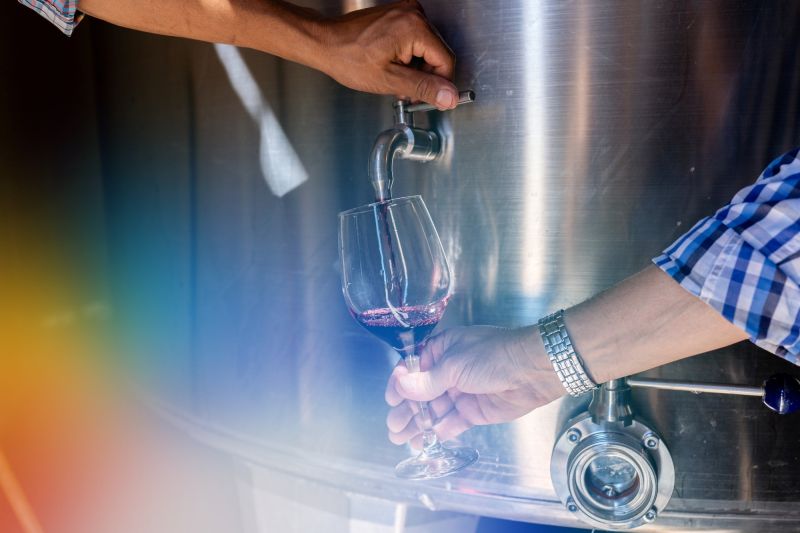
Spain’s wine and grape must production fell in the first 11 months of the 2025/26 marketing year, while domestic consumption, exports and several industrial uses also moved lower, according to a monthly report released Monday by the Spanish Interprofessional Wine Organization, known as OIVE, using data from the Agriculture Ministry’s INFOVI reporting system.
Through June 2026, total accumulated production of wine and must reached 33.1 million hectoliters, down 10.1% from the same period a year earlier, a drop of 3.7 million hectoliters. Of that total, 29 million hectoliters were wine, down 7%, and 4.2 million hectoliters were grape must, down 27.3%.
The June data showed that very little new wine was made during the month itself, just 14,343 hectoliters, leaving cumulative wine production for the first 11 months of the campaign at 28.96 million hectoliters. That was 2.2 million hectoliters below the same period of the previous campaign. OIVE said the must figure came from the expanded November 2025 reporting and stood at 4.2 million hectoliters, compared with 5.7 million a year earlier.
By color, and counting producers making more than 1,000 hectoliters, white wine accounted for 16.3 million hectoliters, down 9.2%, while red and rosé wines accounted for 12.1 million hectoliters, down 4.7%. Producers making less than 1,000 hectoliters reported 610,555 hectoliters, up 12.1%. Castilla-La Mancha remained the center of production, representing 56% of Spain’s wine output in the period and 85% of must production.
Stocks were little changed from a year earlier, though the composition shifted. OIVE said ending inventories of wine and unconcentrated must held by producers of more than 1,000 hectoliters and by storage operators stood at about 33.4 million hectoliters on June 30, down 0.5% from the same date in 2025, or 173,375 hectoliters less. That level was also 7.2% below the average of the last five campaigns, which OIVE put at 36 million hectoliters.
Within that total, wine inventories fell 1.7% to 30.9 million hectoliters, about 0.5 million less than a year earlier. Stocks of unconcentrated must moved the other way, rising 16.2% to 2.6 million hectoliters, an increase of 357,296 hectoliters. Red and rosé wine stocks dropped 7.2% to 17.3 million hectoliters, while white wine stocks rose 6.4% to 13.5 million hectoliters. Castilla-La Mancha again held the largest share, with 11.2 million hectoliters, or 33.5% of total wine and must stocks, followed by Catalonia with 4.5 million and La Rioja with 4.15 million.
Wine sent to other uses also declined sharply over the campaign. In the first 11 months, 1,849,371 hectoliters were directed to producers’ own operations, distillation and vinegar production, down 26.1%, or 654,452 hectoliters less than a year earlier. Of that amount, 1,070,014 hectoliters went to producers’ own operations, a category that includes uses such as aromatized wines, vermouth and sangria, down 6%. Wine sent to distillation dropped 51.6% to 515,383 hectoliters, while wine sent to vinegar production fell 12.2% to 263,974 hectoliters.
June by itself showed a mixed picture in those channels. Wine sent to producers’ own operations rose 4.1% from the same month last year to 139,214 hectoliters. Distillation volumes fell 5.7% to 59,825 hectoliters, while volumes for vinegar production rose 25.8% to 26,054 hectoliters.
Domestic wine consumption remained under pressure on a 12-month basis. OIVE’s estimate for the year through June 2026 stood at 9.05 million hectoliters, down 7.2% from the year through June 2025. That was 706,891 hectoliters less than in the previous 12-month period. The June monthly figure, however, edged higher. The estimated consumption balance for the month rose 0.4% from June 2025, equivalent to 3,017 hectoliters more.
The report said entries of Spanish-origin wine into wineries in June fell 1.4% to 1,751,608 hectoliters, while outflows fell 0.8% to 2,535,135 hectoliters. The net difference, 783,527 hectoliters, was slightly above the level of June last year. OIVE noted that, in the current campaign, estimated consumption rose only in February 2026 and again in June 2026. By color, the trailing 12-month estimate showed red and rosé wine consumption down 12.9% to 5.1 million hectoliters, a decline of 752,623 hectoliters, while white wine consumption rose 1.2% to almost 4 million hectoliters, up 45,732 hectoliters.
Trade data also pointed to weaker demand abroad. Based on INFOVI figures for the first 11 months of the campaign, Spanish wine exports fell 9.9% to 15.2 million hectoliters. Separate customs data from Spain’s tax agency, AEAT, available through May 2026, showed that in the first 10 months of the 2025/26 campaign exports dropped 11% in volume and 7% in value, to 14.2 million hectoliters and €2.275 billion.
May was especially weak. AEAT data showed export revenue in that month down 11.1% to €226.6 million and export volume down 20.1% to 1.3 million hectoliters. For the 10-month period, packaged wines and bulk wines both declined. Packaged wines, including sparkling, fortified, still and bag-in-box products, fell 7.1% in value to €1.86 billion and 6.1% in volume to 647.9 million liters. Bulk wine exports fell 6.9% in value to €415 million and 14.7% in volume to 7.7 million hectoliters. OIVE said the average price for bulk wine rose 9.1% to €54 per hectoliter, while the average price for packaged wine slipped 1% to €2.87 per liter.
On a rolling 12-month basis through May 2026, Spain’s wine exports stood at €2.794 billion, down 5.4%, and 17.5 million hectoliters, down 8.6%. That meant a loss of €161 million in export value and 1.65 million hectoliters in volume compared with the same period a year earlier.
Imports moved in the opposite direction. In the first 10 months of the 2025/26 campaign, Spain imported 891,737 hectoliters of wine, up 16.5%, and spent €277.3 million, up 9.3%, according to the AEAT data cited by OIVE. The average price paid fell 6.1% to €311 per hectoliter. OIVE said the stronger rise in volume was driven largely by bulk wine, whose imports increased 32%, or 137,076 hectoliters.
For the rolling 12 months through May 2026, Spanish wine imports reached €338.9 million, up 8.2%, and 1,046,303 hectoliters, up 13.5%, with the average price easing 4.7% to €324 per hectoliter. That represented 124,310 more hectoliters imported than a year earlier and €25.6 million more spent.