Green or brown beer bottles: why the colour of the glass matters more than it seems
No single colour is automatically better on its own: the difference lies in how each bottle filters light, and in the role colour can play in a brand’s identity.

Views › 421
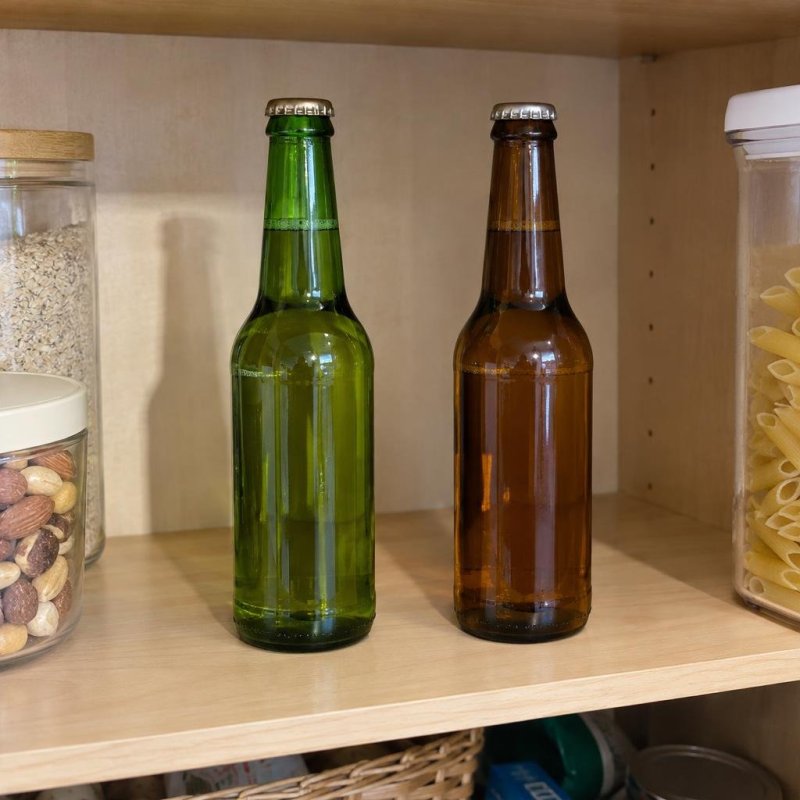
A beer bottle’s colour is not chosen for looks alone. It usually combines two roles that can coexist in the same package: helping protect the beer from light and making a brand instantly recognisable. That is why green and brown or amber do not mean better or worse quality, but different packaging choices.
Green or brown: the colour does more than one job
When beer is bottled in glass, the colour matters because it changes how much light, and what kind of light, can pass through. In general, brown or amber glass usually protects better against the light that can alter a beer’s aroma. But that is not the only reason it exists. The bottle can also be part of a brand’s visual identity, just like its shape or label. That is why green and brown bottles continue to coexist in many markets.
It helps to separate three ideas that are often blurred together. One is the protection the glass offers. Another is the actual condition of one specific bottle. And a third is the overall quality of the beer. A green bottle, by itself, does not prove the beer inside is damaged, and a brown one does not guarantee it is perfect. The issue discussed here depends on the light that reaches the beer and on how much the bottle lets through, not on green or brown glass somehow passing flavour into the liquid.
Three separate ideas
The colour of the glass says something about light protection, not about better or worse quality.
A green bottle does not, by itself, prove the beer is damaged, and a brown one does not guarantee it is perfect.
Where the colour of the glass comes from
The colour is not added like external paint, nor does it later pass into the beer. It is part of the glass itself, created by adjusting its composition and the manufacturing process. In amber glass, common combinations include iron, sulphur and carbon. Some green glass is made with chromium compounds, and iron also plays a role in different shades. Put simply, the colour is built into the bottle during production.
That also explains why not all greens are identical, and not all browns behave in exactly the same way. Under the same visual label, there can be differences in formulation and finish. So it makes more sense to think of green and brown as families of glass, not as one fixed recipe used by every manufacturer. For understanding a beer bottle, the key point is that the colour belongs to the packaging material itself and affects how light gets in.
What light can do to beer
Beer contains substances that can react when exposed to light. One of them is riboflavin, better known as vitamin B2. When it absorbs light, it takes part in reactions that affect hop compounds responsible for bitterness. That chain can end up creating substances with an unpleasant smell. There is no need to memorise chemical names to understand the main idea: light can trigger aroma changes in a finished beer.
This aroma fault is sometimes described with a very vivid comparison: a sharp smell similar to a skunk. The image is used to help people recognise the problem, not to suggest that all bottled beer smells that way or that every green bottle is affected. It is also not helpful to explain the issue only as a matter of ultraviolet rays. Research shows that certain wavelengths of visible light can be involved as well.
That has an important consequence for consumers: the risk does not depend only on leaving a bottle in direct sunlight. Intense or prolonged indoor lighting can also encourage these reactions. This is why bottle colour matters so much in beer: not because the glass changes flavour through contact with the drink, but because it filters light with different levels of effectiveness, including the light that can trigger this aroma fault.
How light can change aroma
-
Light gets in
The beer is exposed to ultraviolet radiation and also to certain visible wavelengths.
-
Riboflavin gets involved
Vitamin B2 absorbs that light and takes part in reactions inside the beer.
-
Hop compounds are affected
The chain of reactions reaches substances linked to bitterness.
-
An aroma fault can appear
In some cases, unpleasant smells develop, sometimes described as skunk-like.
Why amber usually protects better
Among the common colours used for beer, brown or amber glass is usually the most effective at reducing the ultraviolet radiation and blue light linked to sensory changes in beer. The advantage is real, but it needs to be stated carefully: saying it usually protects better does not mean it blocks all light or makes beer immune to poor storage.
Light transmission measurements also show that colour alone does not explain everything. The exact composition of the glass and its thickness both affect how much light gets through. Even within green glass, performance can vary depending on the sample studied. That is why this should not be turned into an absolute rule such as every green bottle protects badly or every brown bottle protects perfectly. The comparison that is useful for readers is simpler: in the beer bottles most people commonly see, amber usually offers a better barrier than green.
| Aspect | Green glass commonly used for beer | Brown or amber glass commonly used for beer |
|---|---|---|
| Light transmission | It usually filters some light, but generally lets more through of the kind that can alter aroma. | It usually does a better job of holding back the light linked to those sensory changes. |
| What you cannot infer | It does not, by itself, prove the beer is damaged. | It does not, by itself, guarantee the beer is in perfect condition. |
| Important nuance | Glass composition and thickness can change the result. | Glass composition and thickness can also change the result. |
So why are green bottles still used?
Because packaging is not chosen only for technical reasons. It can also help make a brand recognisable from a distance and keep its image consistent over time. In its corporate history, Heineken links green to its visual identity. That does not prove every brewer chose the same colour for the same reason, but it does illustrate an important point: in beer, the bottle communicates brand as well as protecting the product.
The contrast with Weihenstephaner shows the other possible priority. This brewer explains its preference for brown bottles in terms of stronger protection from light. Taken together, the two examples show that there is no single universal answer for the whole industry. Packaging can combine light protection with commercial identity. That is why it would be a mistake to read green as a sign of prestige or brown as a sign of ordinary beer.
Two reasons that can coexist in one bottle
Protect from light
Amber is often chosen for its usual filtering advantage.
Weihenstephaner cites that as the reason for preferring brown.
Make the brand recognisable
Bottle colour can also form part of a visual identity.
Heineken links green to that role of recognition.
The useful precaution for both colours
The practical advice is simple and applies to any adult consumer, wherever they live: keep bottles in a cool, dark place, away from the sun and from strong or prolonged light exposure. If the bottle stays inside a closed box that blocks light, that box adds useful protection. This precaution matters for both green and brown glass, because neither one makes beer invulnerable.
In the end, bottle colour tells you something about the packaging, but it is not enough to judge the beer inside. Amber usually offers an advantage against light; green may also reflect brand identity; and in both cases the actual condition will depend on the beer, the type of glass and the exposure it has had. Looking at the bottle helps you understand its role, but storing it well matters more than turning its colour into a verdict.