Why the same wine can seem different in a wine glass, a water glass, a mug or a plastic cup
Wine is only part of the experience: expectations, touch, the rim of the vessel, aroma and temperature all help explain why perception changes from one container to another.

Views › 582
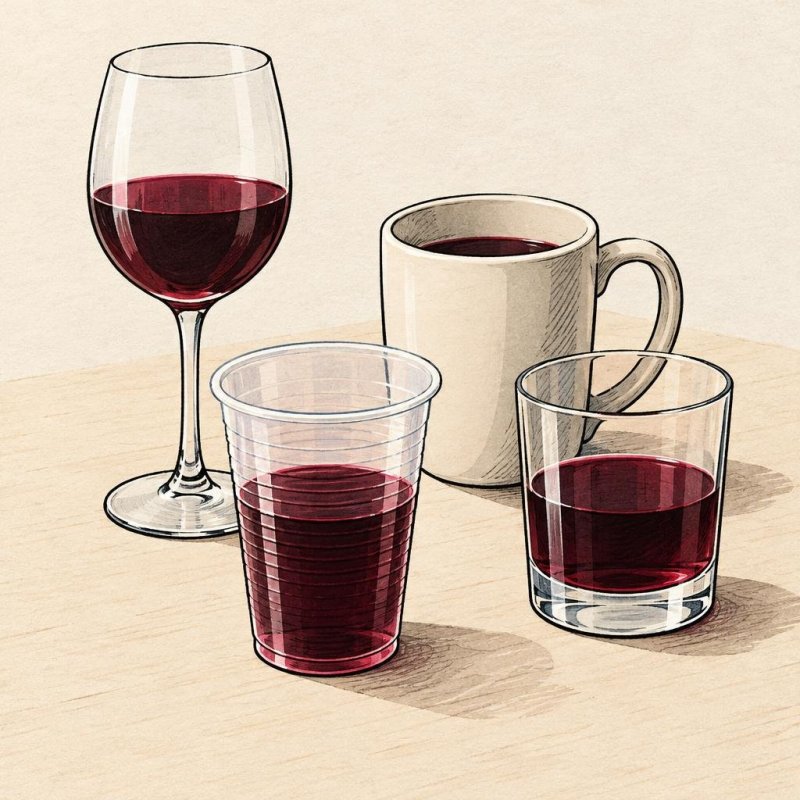
Sometimes the same wine seems to change dramatically when it moves from a fine wine glass to a plastic cup, a ceramic mug or the kind of glass you normally use for water. That feeling does not mean the liquid has somehow gone bad. Part of the answer lies in what the drinker expects, and part in the physical cues the container gives as it reaches the mouth.
The same wine, an experience that can change
The scene is familiar enough: pour the same wine into different vessels and the impression changes. In a plastic cup it may seem different, in a coffee or tea mug it can feel oddly out of place, and in a water glass it can come across differently from a fine wine glass even though the contents are identical. That shift in perception does not, by itself, prove that the wine has changed in composition or that it must taste worse outside a wine glass.
The useful question is not whether one vessel is universally better than another, but what changes in the drinker’s experience. The available evidence helps separate three levels: what is in the wine, the stimuli a person receives while drinking it, and the way the brain interprets all of that. It also calls for caution. There is no controlled study here that compares, within the same test, a fine wine glass, a plastic cup, a ceramic mug and a water glass while holding every other variable constant.
What we call taste is not just on the tongue
In everyday life, when we say something tastes a certain way, we are not talking only about basic tastes detected on the tongue, such as sweetness, acidity or bitterness. Aroma, temperature and texture are part of that experience too. That is why two sips of the same wine can feel different even when the liquid is unchanged: the experience also depends on how the full set of sensory signals is combined and interpreted.
A major part of aroma reaches us through what is known as the retronasal route. These are aromatic compounds that travel from the mouth to the nose internally while we drink and swallow, or while we hold the wine in the mouth for a moment. That joining of taste and smell helps explain something basic: noticing a different experience does not automatically prove that the wine is undergoing a chemical transformation at that moment.
Three ideas that help explain why the experience changes
Taste
What the tongue detects, such as sweetness, acidity or bitterness.
Retronasal aroma
Aromas that reach the nose from the mouth while we drink.
Texture and temperature
They also shape the final sensation, even when the wine is the same.
What the vessel makes us expect before we drink
Before the first sip, we are already reading signals. The look of the vessel matters because we tend to link certain drinks with certain kinds of containers. One study using photographs of alcoholic drinks, including red and white wines, found that the perceived fit between a drink and its vessel influenced how people rated what they saw. That work did not involve actually drinking wine, so it does not show how the wine would taste in the mouth. But it does support the idea that visual context shapes expectations before tasting begins.
Those expectations are not the same for everyone. If you usually drink wine from a wine glass, a water glass or a mug may already feel less appropriate before it even reaches your lips. If that mug reminds you of coffee or tea, that association may come into play as well. Cross-cultural studies on vessels and sensory associations also show differences between groups, so it makes more sense to talk about learned habits than about universal rules governing what every consumer expects.
The idea that expectation can alter enjoyment is not based on images alone. In one experiment with twenty participants, the same wines were served with different price information. Reported pleasantness changed, and so did brain activity linked to the evaluation of that experience, but there was no equivalent effect on perceived intensity. It is important not to claim more than the study shows: the manipulation involved information, not vessels. Even so, it helps explain that the brain does not wait passively for the wine to arrive. It also interprets what it believes it is drinking.
That is why saying “it’s just suggestion” misses the point. Expectation does not make the experience imaginary. It influences how a real flavour is judged. When someone feels that a wine “doesn’t go down the same” from a mug or a plastic cup, they may be responding to a mix of sensory cues and learned meaning, not to a baseless illusion.
Two ways context can influence what you perceive
Before drinking
The look of the vessel can make it seem more or less suitable for wine.
That creates expectations, but it does not measure flavour in the mouth.
During tasting
Prior information can change how much people say they enjoy the same wine.
That effect was observed with price information, not with different vessels.
Hands and lips are drinking too
A vessel is not only seen. It is also touched. In experiments with water, the firmness of the cup influenced how people evaluated what it contained, although not in exactly the same way for every participant. That evidence does not justify saying that any wine in any plastic cup will disappoint, not least because plastic cups are not all equally rigid or flexible. What it does allow us to say is that what the hand feels can form part of the judgement of what we are drinking.
A ceramic mug adds another useful clue: the rim that touches the lips is part of the experience too. Tests carried out with juices and green tea found that rim material and softness could affect thermal sensation and some evaluations of the drink. That does not tell us exactly how a wine will taste in an everyday mug, but it does support a practical idea: physical contact with the vessel is not a minor detail.
Learned association can add to that physical side. For someone who almost always uses a mug for coffee or tea, drinking wine from it may feel less in tune with the usual situation, and that mismatch can colour the experience. The claim should stay within its proper limits: this is a reasonable everyday hypothesis supported by studies on expectation and perceived fit, not an experimentally proven result specifically for wine served in a mug.
The water glass pushes the question a step further, because here it is no longer enough to blame the material. A water glass and a wine glass may both be made of glass and still create different impressions. The most plausible explanation again lies in the combination of habitual use and physical contact while drinking. If that glass belongs, in your mind, to water, the context changes expectation, and the feel of the rim on the lips remains part of the experience. What the sources do not allow us to say is that a finer rim necessarily leads to greater enjoyment of wine for everyone.
There is another important caution: temperature. In wine, it is well established that different serving temperatures alter sensory perception. That means that if one sip is cooler and another warmer, you can no longer attribute the whole difference to the vessel or to expectation. This does not mean that any given material always cools or warms more. It simply reminds us that everyday comparisons easily mix several factors at once.
How a vessel can change the experience without necessarily changing the wine
-
1. You see it
The vessel activates habits and learned associations.
-
2. You touch it
Your hand and lips receive physical cues from the rim and the firmness.
-
3. You drink it
Taste, retronasal aroma, temperature and texture are brought together.
-
4. You evaluate it
The brain combines those signals with prior expectation.
It is not a choice between psychology and physiology
Framing this phenomenon as a choice between “psychological” and “physiological” creates a false opposition. Expectations affect how we evaluate what we drink, and at the same time the vessel provides real physical stimuli: firmness, perceived temperature and the feel of the rim on the lips. All of this is integrated in the brain along with taste and aroma. In other words, psychological does not mean invented, and physiological does not mean free of interpretation.
The available evidence does a good job of explaining the mechanisms, but it does not let us assign them fixed percentages. We do not know how much of the difference between a fine wine glass, a plastic cup, a mug or a water glass comes exactly from expectation, touch, temperature or other variables in any given situation. Nor is there a basis for establishing a universal ranking of vessels. The responsible approach is to distinguish between direct evidence, indirect support and reasonable hypotheses, without turning any personal preference into a general law.
As a practical rule, it helps to separate two ideas that often get mixed together: noticing a difference and enjoying the wine less. You may perceive the wine differently in an everyday vessel and still enjoy it. The opposite can also happen: you may prefer a fine wine glass without that proving the wine is somehow spoiled outside it. If you want to compare for yourself, the sensible approach is to use clean vessels and pour the same wine at a similar temperature, knowing that this helps you observe the experience more clearly but does not isolate all of its causes completely.
If you want to compare for yourself
- Use the same wine in clean vessels.
- Try to keep the samples at a similar temperature.
- Separate noticing a difference from enjoying it less.
- Treat the result as a personal observation, not a universal rule.