What happens if you put a bottle of wine in the freezer and then thaw it out?
The key question is not just whether the wine will taste the same: first check the glass and the closure, thaw it slowly, and know when the bottle is better discarded.

Views › 563
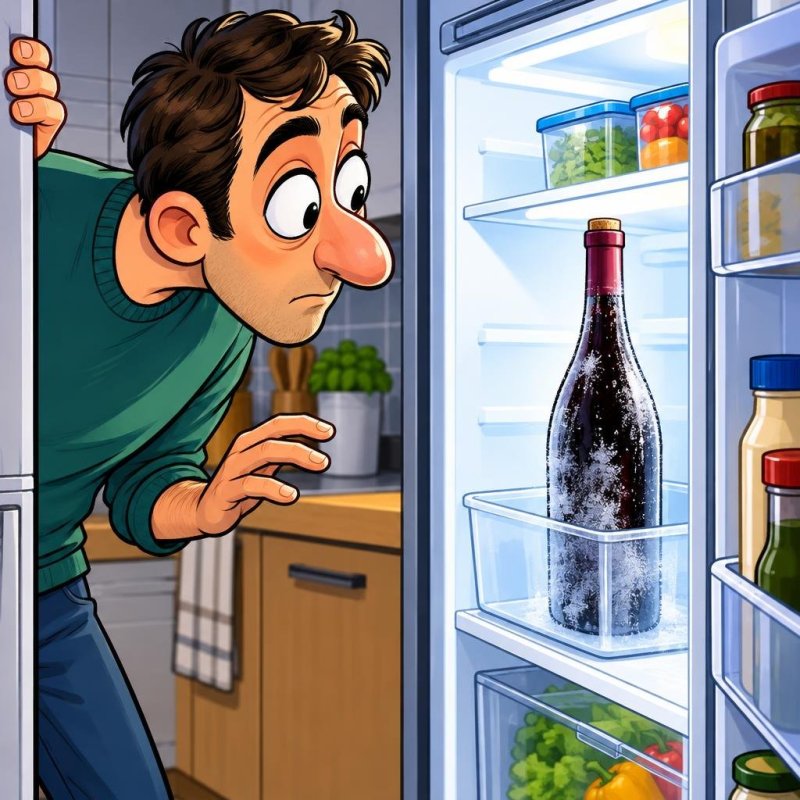
Forgetting a bottle of wine in the freezer does not automatically mean it has to be thrown away. Before wondering whether it will taste the same, the first thing to check is whether the glass and the closure are still safe. Only then does it make sense to decide how to thaw it and whether it is worth opening.
Has the wine been ruined? Check the bottle first
A frozen bottle is not automatically a lost bottle. Once thawed, it may still be perfectly enjoyable. But that is the second question. The first is more practical: whether the bottle has come through the cold and the expansion of the liquid without breaking or compromising the seal.
As the contents get very cold and ice starts to form, the volume can increase and push outward from the inside. That can sometimes force up a cork, cause leaks or affect the seal of a screw cap. In some cases it can also damage the glass. It is a real risk, but not an inevitable outcome in every bottle.
In practical terms, it helps to separate three situations. The first is a bottle that appears intact, with no visible cracks or leaks. The second is a bottle with a raised closure, moisture around it or signs of seepage: that does not by itself mean there is glass in the wine, but it does suggest the seal may have been affected. The third is the clearest case: if the glass is cracked, chipped or broken, the contents should not be used.
Before you think about flavour
A frozen bottle is not always a lost bottle.
The first decision is not sensory: check the glass and the closure before deciding whether to open it.
How to thaw it and when to discard it
If you cannot see any visible damage and you can move the bottle safely, the safest option is to transfer it to the refrigerator and let it thaw there, without applying direct heat. There is no need to speed things up with hot water, radiators or any other heat source. The aim is a controlled thaw, not a forced one.
It is best to keep the bottle upright and, if possible, place it inside a container that can catch any leaks. That will not repair the seal or prove that the bottle is intact; it simply helps contain spills and makes it easier to handle if the closure has given way.
Once the wine has thawed completely, check the neck, the base and the closure again. If the cork has risen or the capsule is damp, there may have been internal pressure and some movement of liquid or air in or out of the bottle. That can affect how the wine keeps, but it does not automatically make the contents dangerous if the glass is intact.
The clear stop line is damaged glass or any reasonable suspicion of contamination from fragments. If there are cracks, chips or breakage, do not drink it and do not use it for cooking. It is also not a good idea to try to rescue it with a homemade filter: the sources reviewed do not support that as a safe method for a bottle that may have been contaminated with glass.
What to do when you find it in the freezer
- Move it only if you can do so safely.
- Stand it upright inside a container and transfer it to the refrigerator.
- Let it thaw without direct heat.
- Check the neck, base and closure again once thawing is complete.
- If there are cracks, chips or a reasonable doubt about glass, discard it.
If it is sparkling, add these precautions
With sparkling wine there is an extra factor: internal pressure. That increases the risk if the bottle has been weakened during freezing. Even if it does not look serious from the outside, it should not be treated like a bottle of still wine.
Do not try to open a sparkling bottle while it is still frozen. Let it thaw first, check that the bottle is sound and keep it cold. Then open it with control: hold the cork, turn the bottle carefully and never point it at anyone.
As for the bubbles, there is no fixed rule. It may keep some of its effervescence or it may have changed more than expected. The sensible approach is not to promise either total loss or perfect preservation before opening it.
Why it freezes and what happens to the alcohol
Wine can freeze even though it contains alcohol. Alcohol lowers the temperature at which freezing begins, but it does not prevent freezing altogether. Dissolved sugars also play a part, so two different wines may not behave the same way in the freezer.
That is why there is no single temperature or time that applies to every bottle. At home, you may find a wine that is only partly frozen, with some of it turned to ice and some still liquid. The whole bottle does not need to become one solid block for expansion and pressure on the closure to have already begun.
It is also not true that thawing somehow makes the wine stronger or strips away its alcohol. If you let the entire contents melt and you do not remove any ice or lose a noticeable amount of liquid, the total amount of alcohol and its overall proportion do not change by magic. What does concentrate the wine is partial freezing followed by physically separating the ice, which is a different process altogether.
So if you want to assess it, wait until the bottle has thawed completely. Pouring only the liquid part from a half-frozen bottle does not give a faithful picture of how the wine tastes after a full thaw and can be misleading.
Three common questions
Does alcohol stop wine from freezing?
No. It lowers the temperature at which freezing starts, but it does not prevent it completely.
Does thawing make it stronger?
No, not if the whole contents thaw and no ice is removed and there are no noticeable losses.
Should you pour it while it is still half frozen?
Better not. Wait for a full thaw if you want a fair idea of how the wine really ended up.
Can you drink it, and will it taste the same?
If the bottle has thawed fully, the glass is intact and there are no signs of contamination, then yes, it can make sense to open it and see how it is. A trip through the freezer does not automatically condemn a wine. It may still be pleasant and entirely enjoyable.
What cannot be guaranteed is that it will show exactly the same character as before. If the closure shifted, if there were small leaks or if the wine went through partial freezing, the sensory result may change. There is no universal measure that can predict possible changes in aroma, freshness or effervescence in a household situation like this.
To judge it fairly, bring the wine to an appropriate serving temperature, then smell and taste it. That step helps you decide whether you want to drink it, not whether it is safe. A normal aroma or a pleasant flavour does not rule out the presence of glass if the bottle was damaged.
What the crystals at the bottom might be
After exposure to cold, crystals may appear at the bottom or stuck to the inside of the bottle. They may be tartrates, natural salts in wine that precipitate when the temperature drops. They are harmless, and their presence does not by itself mean the wine is spoiled.
Some of those crystals may still be there even after the wine has thawed. Not every wine forms them, and not every wine forms them in the same amount. So seeing them does not support a general conclusion about the wine's quality or how much it has changed.
The problem is that at home it is unwise to assume that every crystal is harmless. If the bottle is damaged or there is a reasonable doubt about possible glass fragments, caution should prevail and the bottle should be discarded. Neither a photo nor an informal inspection can turn that doubt into certainty.
Crystals at the bottom: two different readings
Tartrates
They may appear because of the cold and can remain visible after thawing.
They are harmless and do not by themselves mean the wine is spoiled.
Possible glass
If the bottle is damaged or there is a reasonable doubt, discarding it is the safer choice.
Neither an informal inspection nor tasting can certify that it is safe.
How to chill the next bottle without freezing it
If you simply want to cool a bottle for drinking soon, it is better to use the refrigerator or a container with ice and water. These are straightforward methods designed to lower the temperature without pushing the wine to the extreme of freezing.
It also helps not to confuse fast chilling with freezing. A study on wines cooled in a refrigerator or in a mixture of ice, water and salt found no perceptible sensory differences under its test conditions, but that does not show how a bottle that has actually frozen and then thawed will turn out. They are different situations.
The most useful prevention is simple: if you use the freezer for a quick chill, do not turn it into a storage place or rely on a supposedly safe countdown for every wine. Each bottle may react differently depending on its composition and on how cold the freezer really is.