Why beer foam looks white even when the beer is almost black
The answer is not a separate white layer, but what happens to light in the liquid in the glass and in the bubble network that forms the foam.

Views › 512
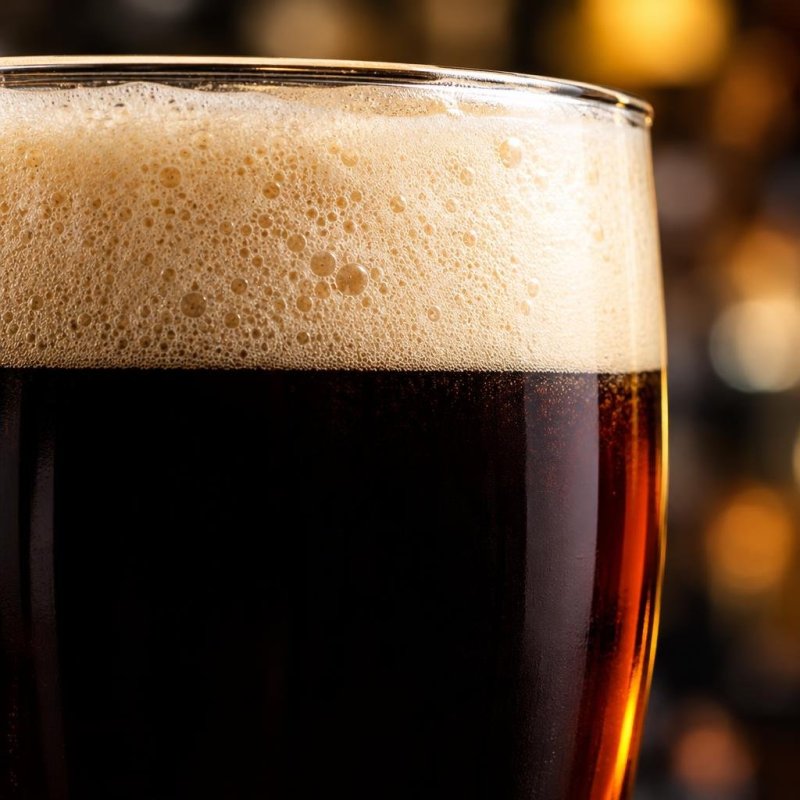
At first glance it seems contradictory: a nearly black beer can hold a very pale head. The key is not that there is a separate white substance on top, but that the same beer, spread out around countless bubbles, makes light behave differently and look much lighter to our eyes.
It is not always white, but it usually looks much lighter
It helps to correct the question from the start: beer foam is not always white. It can look white, cream, beige or even brown, depending on the beer and on the foam itself. In dark styles such as Irish Stout, heads are often described as beige to brown, so the real point is not an obligatory whiteness, but why the foam usually looks much lighter than the liquid underneath.
The short answer is this: in the glass, beer is a continuous mass that lets light pass through a relatively uniform volume; in foam, that same beer is spread into very thin layers around gas bubbles. That change in structure alters how light enters, changes direction and returns to us. That is why a very dark beer can support an off-white or creamy head without losing its colour.
Key idea
Beer foam is not always white: it can look white, cream, beige or brown.
It usually seems much lighter because the same beer is spread around a great many bubbles.
Why the beer in the glass looks so dark
To understand the contrast, you first have to look at the liquid itself. Beer looks dark when some of its coloured compounds absorb part of the light passing through it. In everyday terms, absorbing light means that not all the light that enters the beer makes it back out toward our eyes. The more light is held back along the way, the darker the whole drink appears.
In many dark beers, that deep colour is linked to roasted malts or grains, which contribute compounds responsible for those intense tones. That helps explain why the liquid in the glass can look very dark brown or almost black. But it is best not to turn that into a universal recipe: dark beers are not all made in the same way, and they do not all show exactly the same shade when held to the light.
What foam really is: gas surrounded by beer
Foam is not a solid lid or a white layer separate from the beer. It is made up of huge numbers of gas bubbles separated by thin films of liquid and by small channels where that liquid also collects. In other words, the foam is still beer, just arranged very differently from the liquid filling the glass. That different arrangement is what changes its appearance.
In beer, the dissolved gas is mainly carbon dioxide. As it escapes, it forms bubbles that rise and can gather at the surface. Proteins from the grains help stabilise those thin liquid walls so the foam does not vanish immediately. To explain its colour, there is no need to go much further than that: it is enough to picture a network of bubbles with liquid beer between them, rather than one uniform block of dark liquid.
What happens to light when foam appears
-
In the liquid in the glass
Light passes through a continuous mass of beer.
Some of that light is absorbed, so the whole drink looks darker.
-
In the bubble network
The gas is separated by films and channels of beer.
Light meets many boundaries between gas and liquid.
-
What reaches our eyes
Light changes direction many times, and some of it returns to the viewer.
Under white light, the foam can look whitish or creamy.
Lots of bubbles change the path of light
This is the heart of the explanation. When light enters liquid beer, it moves through a fairly continuous medium and some of it is lost by absorption. In foam, something else becomes very important as well: light runs into a huge number of boundaries between gas and liquid. Each of those surfaces can deflect the light, making it change direction. That process is called scattering. When it happens again and again inside the foam, it is known as multiple scattering.
That back-and-forth movement means some of the light returns toward the viewer instead of travelling straight through the drink. Under white light, the foam sends back a broad mix of colours, which is why it can look white or whitish. It is not that the gas is white or that the foam creates a new colour. What changes is the way light bounces around and spreads through that bubble-filled structure.
Physics studies of foam support exactly that mechanism: the many gas-liquid interfaces strongly alter the way light travels. In those conditions, the final appearance depends not only on the colour of the liquid itself, but also on how the foam scatters light before it reaches our eyes. That is why absorption and scattering do not cancel each other out. Both are happening at the same time, but in foam, scattering can dominate the visual impression.
Two things are true at the same time
The colour is still there
The coloured compounds remain in the liquid around the bubbles.
They do not stay at the bottom or disappear.
The appearance changes
Scattering can dominate the visual impression of the foam.
That is why it usually looks much lighter than the beer in the glass.
The colour is still there, even if it looks different
So where does the beer's dark colour go? It does not sink to the bottom or disappear by magic. The coloured compounds are still present in the liquid surrounding the bubbles and coating their walls. What changes is that light is no longer passing through one continuous mass of beer in the same way it does in the glass. When it meets many thin layers and many changes of direction, the image that reaches the eye can look much lighter even though the original colour has not stopped existing.
That is also why foam does not always look pure white. If the liquid is very dark, it can leave a visible cream, beige or brown tint in the head. Structure matters too: the amount of liquid between bubbles and other features of the foam can make that tint more or less noticeable. The careful approach is not to turn this into an infallible rule based on a single detail, such as bubble size. The reliable idea is the broader one: the liquid's colour still matters, but light scattering can make the foam look much lighter than the beer it comes from.
Seen that way, the apparent contradiction stops being mysterious. A very dark beer can have a pale head because we are not looking at two opposite substances, but at the same drink in two different physical forms: below, a continuous liquid that absorbs a lot of light; above, a bubble network that scatters that light in many directions. That is why the foam so often looks so light. And that is also why it is sometimes not white at all, but cream or soft brown.