Getting the measure of a classic cocktail
Measuring a classic well is not just about repeating numbers: the relationship between ingredients, the syrup, the ice and the technique all change what ends up in the glass.
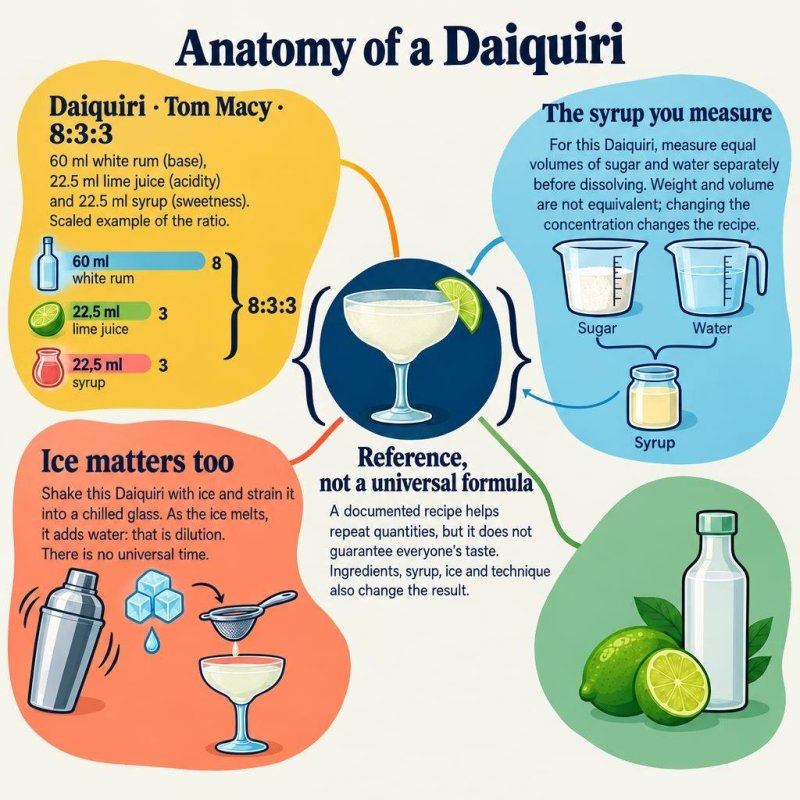
Talking about perfect proportions sounds reassuring, but a classic cocktail does not work because of one magic number that fits everything. What makes a recipe useful is something else: knowing what it is measuring, what each ingredient is doing, and how to repeat the result more consistently before you start adjusting it to your own taste.
A repeatable recipe is not a foolproof formula
A documented ratio makes it easier to make the same cocktail twice with fewer differences from one round to the next, but it does not guarantee that the result will always please in exactly the same way or work with every ingredient. Professional references themselves show different versions within the same cocktail family, making it clear that balance depends on the specific combination, not on turning one numerical ratio into a dogma.
That is why recipes are best read as clearly defined starting points. In this article, the Negroni, the Daiquiri and the Manhattan show three different ways of building a classic: an equal-parts mix, a combination of spirit, citrus and sweetness, and a main formula finished with a small measure of aromatic bitters. They are useful references because they let you compare quantities and technique without presenting one version as the only legitimate or sensorially superior one.
How to read parts and the role of each ingredient
When a recipe speaks in parts, it means a unit of volume that stays constant within that formula. In the IBA Negroni, the 1:1:1 ratio means exactly that: one part gin, one part Campari and one part sweet red vermouth. In the recipe cited, each part equals 30 ml, but the key idea is not the final size of the drink. It is the relationship between its components.
Understanding that difference helps avoid a common mistake: confusing proportion with total quantity. If you double a recipe while keeping the same ratio, you are still making the same cocktail on a larger scale, not a different one. That is why a graduated measure is so useful at home. It does not guarantee that the flavour will seem perfect to you, but it does reduce the variation that comes from eyeballing amounts.
The anatomy of the cocktail changes with each example. In a Daiquiri, the idea of spirit, acid and sweetness fits well: rum, lime and syrup. In a Negroni, the structure comes instead from the interplay between gin, bitterness and sweet red vermouth, with no citrus involved. And in a Manhattan, the main relationship between rye whiskey and sweet red vermouth sits alongside a dash of aromatic bitters, which should not be confused with the role or the volume of Campari in a Negroni.
Four terms that make a recipe easier to read
Part
A unit of volume that stays constant within the formula.
In a 1:1:1, all parts contain the same amount.
Dash
A brief charge from the bitters bottle.
In the Manhattan cited here, it has no universal equivalent in millilitres.
Simple syrup
Sugar dissolved in water.
Its concentration and the way it is measured are also part of the recipe.
Dilution
The water that enters the mix when part of the ice melts.
It affects texture, temperature and the overall perception of the drink.
Three classics, three ways to build balance
The IBA Negroni is the clearest example for learning how to read a ratio: 30 ml of gin, 30 ml of Campari and 30 ml of sweet red vermouth, a 1:1:1 relationship. It is built directly in a chilled low glass, over ice, and stirred gently. Here, balance does not come from softening acidity but from making the alcoholic base, the bitterness and the vermouth’s wine-based sweetness work within the same measure.
The Daiquiri used here is not the IBA version but Tom Macy’s. Its ratio is 8:3:3, which can be scaled, for example, to 60 ml of white rum, 22.5 ml of lime juice and 22.5 ml of simple syrup made with equal volumes of sugar and water. It is shaken with ice and strained into a chilled glass. These figures are a metric scaling of his ratio, not an exact conversion from ounces, and that precision matters if you want to avoid mixing different recipes under the same name.
This Daiquiri also shows something important: two ingredients can occupy the same volume and do very different jobs. The fact that the lime and the syrup appear here in equal amounts does not mean they contribute the same thing or can be adjusted automatically. One brings acidity; the other brings sweetness and texture depending on how that syrup was made.
The IBA Manhattan follows another logic. The recipe calls for 50 ml of rye whiskey, 20 ml of sweet red vermouth and a dash of Angostura. A dash is a brief charge from the bitters bottle and has no universal equivalent in millilitres. Its main ratio can be read as 5:2, but the aromatic bitters sit outside that count because they are not working on the same volumetric level. That is exactly why they should not be treated as equivalent to the Negroni’s 30 ml of Campari: both add bitterness, yes, but they are different ingredients, used in different amounts and with different functions in the mix.
Using these formulas as references does not mean treating them as absolute truths. The IBA offers a useful professional codification for identifying well-known recipes, and Macy’s version shows one specific professional preference for the Daiquiri. For the consumer, the valuable thing is not choosing sides but knowing which recipe you are starting from each time.
| Cocktail | Reference formula | Technique |
|---|---|---|
| Negroni | 1:1:1. 30 ml of gin, 30 ml of Campari and 30 ml of sweet red vermouth. | Built directly in a chilled low glass, over ice, with a gentle stir. |
| Daiquiri | Tom Macy version: 8:3:3. Scaled example: 60 ml of white rum, 22.5 ml of lime juice and 22.5 ml of syrup. | Shake with ice and strain into a chilled glass. |
| Manhattan | 5:2 plus a dash of Angostura. 50 ml of rye whiskey and 20 ml of sweet red vermouth. | Stir with ice and strain into a chilled glass. |
Before you measure the sweetener, identify the syrup
In cocktails, simple syrup means sugar dissolved in water. It may sound like a minor detail, but it is as much a part of the recipe as the spirit or the citrus. If a formula does not make clear which syrup it uses, reproducing it accurately becomes harder, because sweetness and texture do not depend only on the number of millilitres poured.
Not all syrups called simple are the same, either. Sources distinguish between 1:1 and 2:1 syrups. The order is sugar:water, so 1:1 means equal amounts and 2:1 means two parts sugar to one part water. That ratio should also state whether it is expressed by weight or by volume. Those are different methods and they do not produce the same result. So it makes little sense to swap one syrup for another in the same quantity as if nothing changed.
In Tom Macy’s Daiquiri, the syrup is defined clearly: equal volumes of sugar and water, measured separately before dissolving. That detail matters just as much as the 8:3:3 ratio. If you replace that syrup with a more concentrated one or with one made under a different convention, you are no longer reproducing the same recipe, even if the shaker still gets the same number of millilitres.
It also helps to avoid unreliable shortcuts. A recipe that uses solid sugar cannot simply be translated into an exact syrup quantity if the source does not provide that equivalence, and a 2:1 syrup should not be treated as a universal substitute for 1:1. Measuring sweetness properly starts with knowing what you are measuring.
The syrup changes the recipe too
A 1:1 syrup and a 2:1 syrup are not interchangeable just by keeping the same millilitres.
The ratio should state whether it is measured by weight or by volume, because those are not the same thing.
The water from the ice matters too
Proportions do not stop at the bottle or the juicer. Some of the water in a cocktail comes from the ice as part of it melts during mixing. That is called dilution, and it changes texture, temperature and the way you perceive alcohol, bitterness, acidity or sweetness. It does not usually appear as a fixed number in the recipe, but it is still part of the final result.
Technique determines how that water gets in. Shaking means mixing by agitating the drink in a suitable vessel; stirring means mixing with a spoon. In the Daiquiri version used here, the drink is shaken with ice and then strained. In the IBA Manhattan, it is stirred with ice and then strained into a chilled glass. In the IBA Negroni, the mix is built directly in the glass over ice and brought together with a gentle stir. This is not a hierarchy of methods. It is the technique attached to each specific reference.
What does not help is turning this into a false universal rule. The condition of the ice, its temperature and how it has been stored all affect chilling and dilution, so there is no number of seconds or water percentage that works for every kitchen, every freezer tray or every glass. The recipe gives you the method; consistency comes from repeating it carefully.
How to adjust a recipe without losing the starting point
The most useful way to personalise a classic is not to begin by changing everything, but to make the reference version first exactly as written, with its syrup and its technique. That gives you a recognisable base. Without it, any later adjustment becomes hard to interpret because you no longer know which variable is really changing the result.
Then taste a small sample once the mix is already cold and diluted, identify what you would like to change, and alter just one variable in the next round. Writing it down helps far more than it seems. If you change the syrup, the amount of lime and the way you shake all at once, there is no way to know what actually produced the difference.
In a Daiquiri, for example, aiming for less perceived acidity can take you down different paths: reducing the citrus is not the same as increasing the syrup. Both moves change the balance, but not in equivalent ways. One removes acidic tension; the other adds sweetness and can alter the sense of body depending on the syrup used. That is why it is worth changing only one thing at a time.
That, in the end, is the real meaning of talking about ratios that do not let you down: not a mathematical guarantee, but a reference recipe that lets you repeat, compare and learn. If a mix seems rounder or softer to you, that describes only a sensorial preference. It does not change the essential point: it is still an alcoholic drink for adult consumption, and its balance depends on quantities, ingredients, ice and technique, not on a universal formula.
A simple way to adjust without losing the reference
- Make the chosen recipe first exactly as written, with its syrup and its technique.
- Taste a small sample once it is already cold and diluted.
- Decide what you want to change and adjust only one variable in the next round.
- Write the change down so you know what really altered the result.