When rum colour misleads
A bottle’s colour looks like a direct clue, but with rum it helps to separate what you see from what ageing and production really tell you.
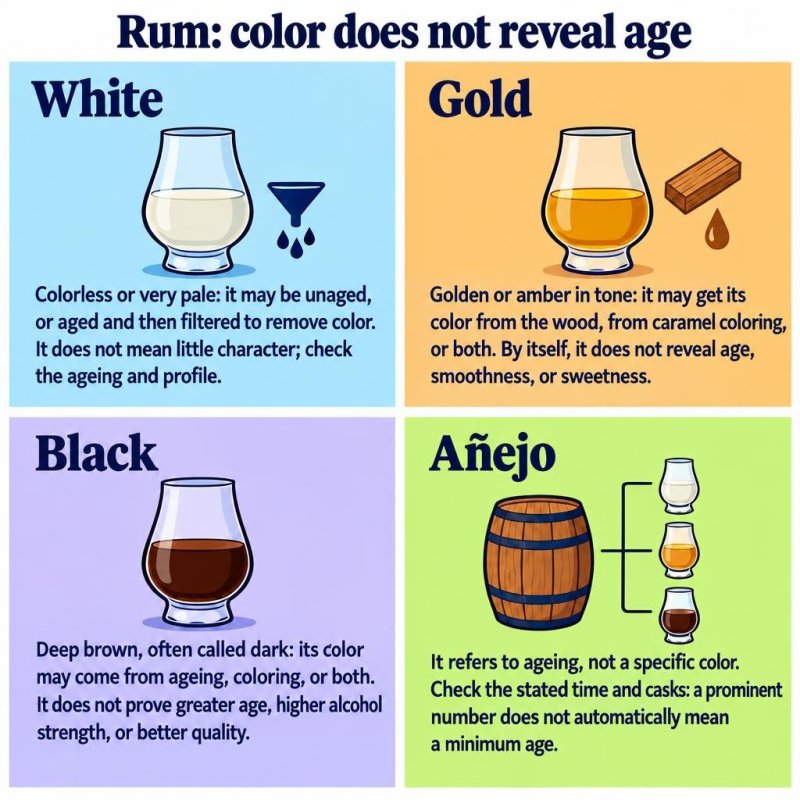
White, gold, black and añejo look like easy labels to read, but they do not tell the same story. Separating colour from ageing helps you read a bottle better, avoid assumptions and choose a rum for the job you actually want it to do.
The key point: colour and ageing are not the same scale
The first thing to clear up is that these four terms do not form a universal ladder from younger to older, lighter to fuller, or simpler to better. White, gold and black mainly describe how the rum looks in the glass, while añejo points to something different: time spent ageing, as declared by the brand. These are dimensions that can overlap, not fixed boxes that always exclude one another.
That is why an aged rum can look pale if it has been filtered to remove colour, and why a dark rum does not prove long ageing on its own. Colour also does not confirm higher alcohol, more sweetness or better quality. It can guide the eye, but it is not enough to explain how the rum was made or what the final result will be like.
The clue that avoids confusion
White, gold and black speak mainly about appearance.
Añejo speaks about declared ageing and can describe a clear rum or a dark one.
What rums share, and why they can still be very different
All rum starts with raw materials from sugar cane. One of the most common is molasses, a thick syrup left after sugar processing, although cane juice or cane syrup can also be used. Then come fermentation, when yeast turns sugars into alcohol, and distillation, which concentrates that alcohol and other aromatic compounds in the spirit.
From there, many choices can change the profile: distilling in a column still or a pot still, ageing in wood or not, blending different rums, filtering to lighten the colour or adjusting the appearance. Filtration aimed at reducing colour means passing the rum through a material that retains some of that colour, such as charcoal. That is why a spirit with ageing can still end up looking very pale. Put those steps together and it becomes easier to see why two rums with a similar appearance can taste quite different.
Four useful terms
Molasses
A thick syrup from sugar cane used as the raw material in many rums.
Fermentation
The process in which yeast turns sugars into alcohol and creates part of the aromatic compounds.
Distillation
The stage that concentrates alcohol and aromas in the spirit.
Filtration
A step that can remove part of the colour and leave an aged rum looking very pale.
White, gold, black and añejo side by side
White rum usually means the liquid is colourless or very pale. That does not automatically mean unaged: it may never have touched wood, but it may also have been aged and then filtered to remove colour. White does not mean neutral or low in intensity either. Some white rums have plenty of aromatic character. One example is Hampden Rum Fire, presented by its producer as a white rum with a powerful profile. The useful takeaway is to check whether the bottle explains anything about ageing and style.
Gold rum usually refers to golden or amber tones. That colour may come from wood, from caramel colouring, or from a combination of both. What matters is not treating it as a compulsory middle stage between white and black. Gold on its own does not tell you how many years the rum spent in cask, whether it will be smoother, or whether it will taste sweeter. If the bottle does not explain the ageing or the style, colour alone leaves too many questions unanswered.
Black rum, and often dark rum as well, is used for rums with a very deep brown colour. In the market, the two terms can overlap, but that does not create a global rule or a higher category. A very dark colour may come partly from ageing, partly from colouring decisions, or from both at once. What it should not be turned into is an automatic synonym for greater age, higher alcoholic strength or better quality.
Añejo gives you a different kind of information. It does not describe a specific colour but a stated reference to ageing. For that word to be genuinely useful, it helps to see whether the bottle or producer explains the declared time, the type of casks or how rums of different ages are blended. Wood can contribute aromatic compounds and its own nuances, but more years alone do not guarantee that you will enjoy it more. And an aged rum can still end up looking clear if it is filtered.
| Term | What it usually describes | What to check on the bottle or product sheet |
|---|---|---|
| White | A colourless or very pale appearance | Whether there was ageing, filtration and what profile it declares. |
| Gold | Golden or amber tones | Whether the colour is linked to wood, colouring or both. |
| Black or dark | A deep brown colour | Whether there is information on ageing, colouring and alcoholic strength. |
| Añejo | Declared ageing, not a colour | How the time, casks, blend of ages and any filtration are explained. |
What can change flavour, beyond the colour
A rum’s profile does not come from colour but from its whole journey. The raw material, fermentation, distillation and ageing all influence the aromas that appear in the end. That is why it makes more sense to look for concrete descriptions such as fruity, vegetal, spicy, toasted or with a clear wood influence than to rely on rigid shortcuts like white equals light or black equals intense. Even within white rum, there are very expressive styles far removed from any idea of neutrality.
It also helps to separate aroma from composition. If a rum suggests vanilla, caramel or nuts, that does not by itself prove added sugar, just as being made from sugar cane does not mean it will taste sweet. Some of those notes can be created or reshaped during fermentation, distillation and ageing in wood. If a bottle says nothing about additions, the sensible move is not to invent them, but not to rule them out from colour or aroma alone either.
What to check on the bottle and in the producer’s information
If you want to look beyond colour, three basic points are worth checking. The first is alcoholic strength, which shows the proportion of alcohol by volume and should not be confused with aromatic intensity. The second is any clear ageing statement: years, a blend of ages, cask type or mention of filtration. The third is the profile description, if there is one, because a concrete clue about style helps more than a single word such as gold or black.
Commercial numbers need careful reading. A prominent number on the label does not always mean the same thing from one brand to another, and it does not automatically prove a minimum age. Appleton Estate says its age statements refer to the youngest component in the blend, while Zacapa describes No. 23 as a blend of rums aged between six and twenty-three years, not as a rum with a minimum age of twenty-three years. These examples support one practical idea: before assuming a number means years of ageing, look for the full explanation.
A lack of information says something too, but not everything. If a bottle does not explain casks, ageing time, filtration or additions, that point should remain unknown. It is not wise to fill the gap with assumptions such as it does not mention ageing, so there is none, or it is dark, so it must be stronger. When the label offers little context, the sensible decision is to accept that uncertainty and not turn colour into an answer it cannot provide.
A quick check before you choose
- Check the alcoholic strength: it indicates alcohol by volume, not aromatic intensity.
- See whether numbers on the label are explained: not every commercial number equals a minimum age.
- Check whether ageing, casks, a blend of ages or filtration are declared.
- If key details are missing, leave that part as unknown and do not fill it in from the colour.
How to choose based on what you want to make or enjoy
Your intended use is far more helpful than appearance when choosing well. If you are following a recipe, look at the style and strength it asks for. Some classic cocktails use white rum, while others call for amber or Jamaican profiles. That shows the decision depends on the role the rum plays in the mix, not on a fixed rule based on colour. Swapping one bottle for another of the same shade can still change the result quite a lot.
If you plan to drink it without other ingredients, your own preference should come first. You may want a rum that is fruitier, spicier, more marked by wood or simply lighter on the palate. The idea that white is for mixing and añejo is for sipping does not hold up here either. Some producers position aged rums for both neat drinking and cocktails, and there are also clear rums with plenty of personality. What helps is comparing the stated profile and production information, not obeying an imaginary colour hierarchy.
A simple sequence can help you decide: first define what you want it for; then think about the profile that appeals to you; finally check what the bottle says about alcoholic strength, ageing and production. If that information is there, you have better guidance than colour alone. If it is missing, the sensible response is to recognise that you know less about that rum, not to complete the story with assumptions based on white, gold, black or añejo.