Whisky with chocolate or chips: why it sometimes works better than you’d think
Everyday chocolate or potato chips can work well with whisky if you understand what aroma, contrast, texture and intensity bring to the pairing, without expecting a perfect match.
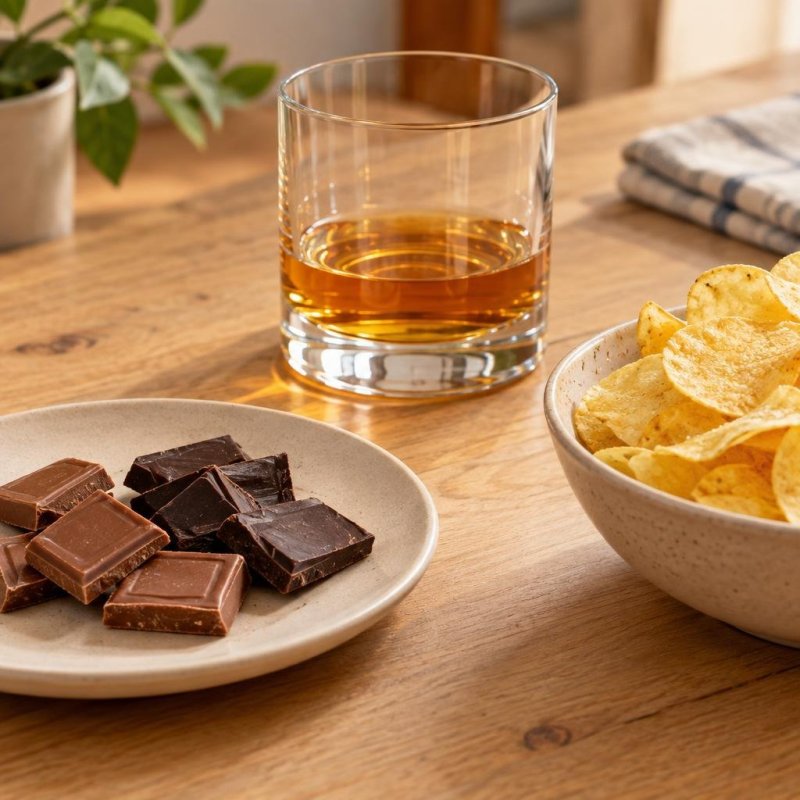
There is nothing remotely heretical about having a whisky with an ordinary bar of chocolate or with a bag of potato chips. The key is not to chase a perfect match, but to understand what might click through aroma, contrast, texture and intensity so you can try a simple first pairing at home.
“Forbidden” only as a joke: what pairing means
Here, “forbidden” is just a wink at unnecessary solemnity. Pairing whisky with chocolate or with chips breaks no universal gastronomic rule, and the Scotch whisky sector itself includes both milk and dark chocolate among possible accompaniments. That does not mean every combination will appeal to everyone, but it does stop this from being treated as a pointless oddity.
Pairing simply means putting a drink and a food together to see how they change in each other’s company. In simple combinations like these, four easy things matter: aromatic affinity, taste contrast, texture and intensity. A whisky can suggest vanilla or caramel without being a sugary drink; that aromatic impression is not the same as sweetness. And alcohol burn is not a flavour either: it is a separate sensation, and if it dominates, it can hide everything else.
Four ideas that explain the pairing
Affinity
When whisky and food share aromatic echoes, such as vanilla or caramel.
Contrast
When the pairing works through difference, such as a salty bite against sweet-smelling notes.
Texture
How they feel in the mouth matters: melting with chocolate, crunchy with chips.
Intensity
If the alcohol or one flavour dominates too much, it can hide everything else.
Milk or dark chocolate: two easy ways in
A friendly starting point is a plain milk chocolate, with no fillings or added flavours, alongside a whisky that reminds you of vanilla or caramel. The idea is continuity: one aroma leads naturally into the next. Chocolate and whisky professionals have described that kind of affinity as a possible pairing, but it is best treated as an experiment, not a rule. If the chocolate is so dominant that the whisky disappears, the pairing is not working for you, even if it looks logical on paper.
Dark chocolate has a place too, but not because a higher cocoa percentage guarantees a better result. The more useful reference point is simpler: choose a dark chocolate whose bitterness you already enjoy on its own, and try it with a whisky that has a stronger aromatic presence. Some recommendations from the Irish whiskey sector follow exactly that logic of matching intensities, while consumer studies show there is no magic percentage that always wins and that your prior liking for the drink matters a great deal.
Texture matters with chocolate as well. It starts as a solid when you bite it, then melts in the mouth and clearly changes the feel of the pairing. That transition can make the combination feel either more enveloping or simply heavier, depending on the case. What matters is not to overstate what we know: studies on oral processing and lubrication help explain why chocolate feels like this, but they do not prove that it neutralises alcohol or improves every whisky.
Two starting points with chocolate
Milk chocolate
Best if it has a simple flavour, with no fillings or added flavours.
It can suit whiskies that remind you of vanilla or caramel.
Dark chocolate
Start with one whose bitterness you already enjoy on its own.
It often makes more sense with a whisky of stronger aromatic presence.
Potato chips: salt, contrast and crunch
For the second route, it helps to be precise: here we mean bagged potato chips, the crisp kind, not fries. The best first try is usually a plain salted bag, without strong extra seasonings. Not because it is superior, but because it reduces the number of variables and lets you notice more clearly what the whisky brings and what the bite brings. If you start with very bold flavours, it becomes harder to tell whether you like the pairing itself or just the seasoning.
What makes chips interesting is contrast. A salty bite can feel pleasing next to a whisky that suggests vanilla, honey or caramel, because it brings together two different profiles rather than chasing similarity. There is also general evidence that salt can reduce certain bitter tastes under some conditions, which helps explain why some people find the combination gentler overall. Even so, that mechanism has not been demonstrated specifically for whisky with chips, so it does not justify promises of less burn or more sweetness.
Crunch matters too. Eating chips is not only about salt and fat: the bite and the sound are part of the experience. Research shows that those cues influence how we perceive crispness and freshness. That helps explain why this pairing can feel fun alongside a liquid, aromatic drink. What it does not do is prove that louder chips pair better with whisky or that they necessarily “cleanse” the palate.
The most useful first bag
To try whisky with chips, start with bagged potato chips, the crisp kind, salted and without strong seasonings.
The point is not that they are better, but that fewer variables make the contrast and crunch easier to notice.
How to run a simple test at home
There is no need for a formal tasting. Start with small amounts and try each item on its own. Take a short sip of whisky and notice only whether it reminds you of something familiar, such as vanilla, caramel, fruit, spice or smoke. Then taste the chocolate or the chips on their own. After that, combine them: with chocolate, let it melt a little before going back to the whisky; with chips, try a small bite and then another sip. Doing the two tests separately makes it easier to see what each accompaniment is actually changing.
If, once combined, all you notice is burn, the issue may not be the pairing at all but the alcohol intensity. In that case, it can make sense to add a little water to the whisky and try again, with no fixed ratio and no need to turn the gesture into a ritual. We know that the perception of ethanol changes with concentration, and that burn can overpower other sensations; some distilleries also give practical advice along those lines. What does not exist is a proven ideal dilution for chocolate or chips.
A quick test at home
- Try the whisky and the food separately first, in small amounts.
- With chocolate, let it melt a little before returning to the whisky.
- With chips, take a small bite and then another sip.
- If all you notice is burn, add a little water to the whisky and try again.
- Change only one variable at a time to understand what improves and what you simply do not enjoy.
How to tell whether you really like it
The useful question is not whether the pairing is correct, but whether you can still recognise both products and enjoy them together. If the chocolate completely buries the whisky, try a less sweet one or a whisky with more aromatic presence. If a dark chocolate leaves you with nothing but bitterness, look for another one whose profile you already enjoy. If plain salted chips are good on their own but the contrast with the whisky does not convince you, there is no reason to force it: that pairing may simply not be for you.
When you adjust something, change only one variable at a time. Keep the same whisky and try a different chocolate, or keep the same chips and add a little water to the whisky. That makes it much easier to understand what was not working. It also helps to stay realistic: a sensible sensory explanation does not guarantee pleasure, professional recommendations are not universal proof, and these foods do not protect you from the effects of alcohol. Sometimes the best decision is to accept that an interesting idea is not for you and move on to another one.