Valtellina spotlights 2,500 kilometers of UNESCO-listed dry-stone walls
The Oct. 17 observance highlighted the mortarless craft that sustains 750 hectares of terraced vineyards in northern Italy
Wednesday, October 21, 2026
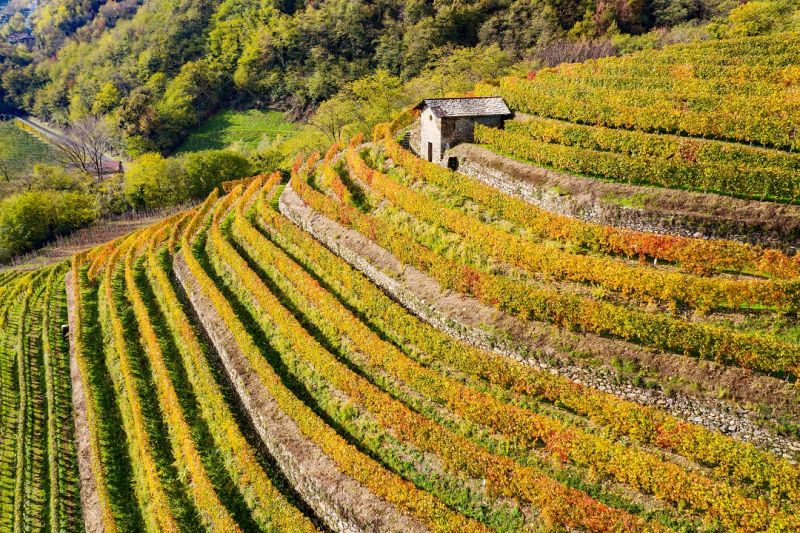
In Valtellina, a mountain wine region in northern Italy, the craft of building dry-stone walls has again been placed at the center of public attention as local institutions and producers marked the International Day of Intangible Cultural Heritage on Oct. 17. The practice, recognized by UNESCO in 2018, is seen in the area as a foundation of the steep terraced vineyards that define much of the valley’s landscape and its wine production.
Dry-stone walling is an old construction method based on stacking and fitting stones without cement or mortar. In Valtellina, that technique has done more than shape the scenery. It has made cultivation possible on hard mountain slopes, helped stabilize the ground, and reduced hydrogeological risk in a territory where farming has long depended on careful work along narrow terraces.
The Valtellina vineyard system stretches between the municipality of Buglio in Monte and the town of Tirano, from about 300 meters above sea level to nearly 800 meters. Across that area, the dry-stone walls extend for about 2,500 kilometers and support roughly 750 hectares of terraced land, much of it planted with vines. The terraces have also been recognized as a historic rural landscape, reflecting the work of generations of farmers who adapted the mountainside to agriculture stone by stone.
For the valley’s wine sector, the walls are tied directly to what Italians often call “heroic viticulture,” or farming carried out under especially difficult geographic conditions. In Valtellina, vineyards are carved into steep terrain and require significant manual labor. The dry-stone structures hold the terraces in place and create the narrow bands of cultivable land where vines can grow. They are also part of a broader relationship between people, nature, and landscape that has shaped the region for centuries.
The grape most closely linked to that system is Nebbiolo, known locally as Nebbiolo delle Alpi. It is the leading variety behind the valley’s best-known wines, including Valtellina Superiore DOCG and Sforzato di Valtellina DOCG. In this setting, the grape is grown in an environment where altitude, slope, and traditional farming techniques all play a role, and where the physical structure of the terraces is inseparable from the identity of the wines.
The Oct. 17 observance was used to highlight not only the walls themselves but the transmission of the knowledge behind them. UNESCO’s recognition in 2018 focused on the craft of constructing dry-stone walls as intangible cultural heritage, meaning the value lies not only in the finished structures but in the know-how, manual skill, and community practice passed from one generation to the next. Builders must choose stones carefully, place them without binding materials, and create walls that can withstand time, weather, and the pressure of the soil behind them.
In Valtellina, that knowledge exists alongside other UNESCO-recognized intangible traditions connected to mountain life. They include transhumance, the seasonal movement of livestock between grazing areas, and alpinism, both of which reflect long-standing ways in which communities have lived with and moved through alpine terrain. Though different in practice, these traditions share a strong link to the mountains, the landscape, and the people who depend on them.
The focus on the walls also draws attention to the wider cultural economy of the valley. Valtellina’s food and wine traditions are closely tied to its agricultural history and to the physical limits of mountain farming. Local products known well beyond the region include Pizzoccheri della Valtellina IGP, Bresaola della Valtellina IGP, and the cheeses Bitto DOP and Valtellina Casera DOP. These foods are not part of the UNESCO recognition for dry-stone walling, but they are part of the same living landscape in which local knowledge, cultivation, and identity remain closely connected.
At the national level, Italy’s intangible cultural heritage includes a wide range of traditions and practices that UNESCO has recognized over time, from truffle hunting to Italian cuisine. In Valtellina, the dry-stone walls stand out because they show how a technical skill can also be a cultural marker and an economic necessity. Without them, much of the valley’s steep vineyard area would be difficult or impossible to farm.
That is why the walls are often described in Valtellina not simply as a historic feature, but as the hidden framework of the region’s vineyard system. They support the land physically, but they also preserve a rural model that depends on manual care and local knowledge. In a region where mountain agriculture remains exposed to climate, slope, and abandonment risk, the continued maintenance of those walls is treated as both a cultural duty and a practical requirement for keeping the landscape productive.