Vittorio Frescobaldi, who helped modernize Tuscan wine, dies at 97
He led Marchesi de’ Frescobaldi for decades, steering the 700-year-old family business into global markets.
Thursday, August 27, 2026
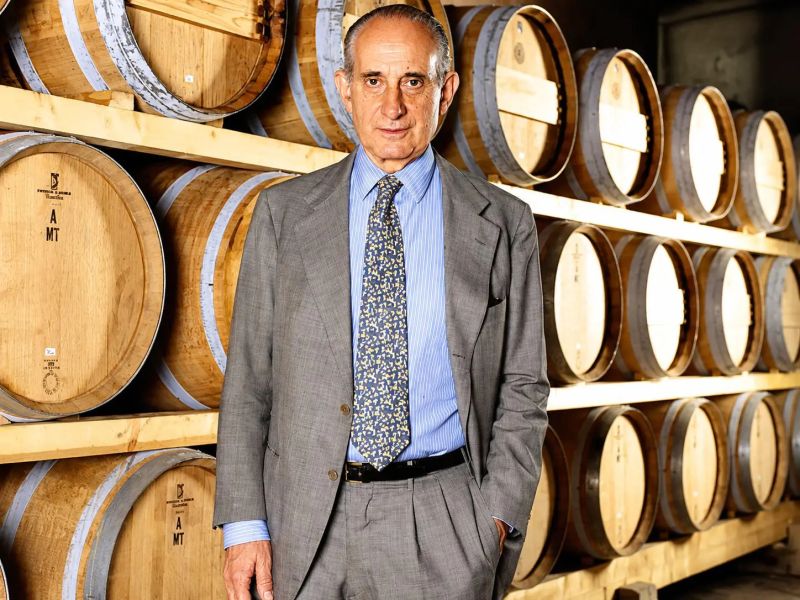
Vittorio Frescobaldi, the longtime leader of one of Italy’s oldest wine families and a key figure in the modernization of Tuscan wine, died Aug. 26 in Florence. He was 97. His death was reported by Marchesi de’ Frescobaldi and several wine industry publications. A cause of death was not publicly disclosed.
Frescobaldi was born in Florence in 1928 into the 31st generation of a family whose history in wine stretches back more than 700 years. After studying agricultural science, he joined the family business and later took on greater responsibility after the death of his father, Lamberto, in 1959. He spent most of his working life at Marchesi de’ Frescobaldi and served as president of the company from 1980 to 2007, before handing daily leadership to the next generation.
His career covered a period when Tuscan wine was changing rapidly. In the 1960s and 1970s, many producers were trying to overcome an outdated image and improve quality. Frescobaldi was among the vintners who pushed that shift. Under his leadership, the family business invested in vineyard management, winemaking, and exports, helping turn a historic estate into a company with a larger international presence.
He worked alongside his brothers Ferdinando and Leonardo to expand sales abroad in the 1970s, when Italian wineries were still learning how to serve distant markets. Industry accounts describe that period as a formative one for the family, as it built distribution channels and practical knowledge that later supported wider global growth. In later years, Frescobaldi frequently urged Italian producers to look beyond the domestic market at a time when wine consumption in Italy was weakening.
Frescobaldi also played a role in changing how vineyards were farmed. According to Wine Spectator, he oversaw a move away from the traditional Tuscan sharecropping system toward a wage-based labor model. He was also an early advocate of planting grape varieties in separate vineyard blocks rather than mixing red and white grapes together, a practice that was common in Chianti for many years. That approach made it easier to harvest each variety at the right time and reflected a broader move toward more precise viticulture.
Some of the best-known business decisions of his career came in Montalcino and Bolgheri. In 1989, the family bought Castelgiocondo in Montalcino, strengthening its position in Brunello. In 1995, the Frescobaldi family entered a joint venture with Robert Mondavi’s family to create Luce delle Vite, a project that drew international attention to Montalcino and to a new style of Tuscan wine. In 2002, Frescobaldi again partnered with the Mondavis in Bolgheri through the acquisition of Ornellaia. Marchesi de’ Frescobaldi later took full control of the estate, including the Masseto vineyards, bringing one of Italy’s most sought-after wine properties into the family group.
The company continued to grow after those deals. It added estates beyond its traditional base, including Attems in Friuli, and more recently expanded into Sicily’s Mount Etna and Oregon’s Willamette Valley. That growth was built on a strategy closely associated with Vittorio Frescobaldi: preserving the identity of Tuscan wine while using international partnerships and foreign markets to broaden the business.
His influence extended beyond his own company. In 1977, he was named Cavaliere del Lavoro, an Italian state honor for achievement in business and agriculture. From 1986 to 1990, he served as vice president of Confagricoltura, one of Italy’s main agricultural organizations. According to The Drinks Business, he was also involved with Vinitaly from its earliest years and helped support the development of the Verona trade fair into one of the wine industry’s main events.
Tributes came quickly from across Italian wine and agriculture. Piero Antinori, another leading Tuscan producer, told Wine Spectator that Frescobaldi had been “an example to follow” for his passion for the land, balance, and wisdom. Federico Bricolo, president of Veronafiere, called him “a towering figure in the Italian wine world” and said he helped give both his company and the wider sector stronger international momentum. Italy’s agriculture minister, Francesco Lollobrigida, said Frescobaldi had helped carry the name of Italian agriculture and winemaking around the world while linking tradition to a forward-looking vision.
Frescobaldi remained an important figure for the family even after stepping back from management. His son Lamberto, who has led Marchesi de’ Frescobaldi in recent years, has publicly credited him with inspiring his own career in wine and respect for vineyard work. The company today manages a large portfolio of estates and produces millions of bottles a year, a scale that reflects the expansion carried out during Vittorio Frescobaldi’s time in leadership.
He is survived by his wife, Bona, and their children, Fiametta, Angelica, Lamberto, and Diana.