Valpolicella Begins Its 2026 Grape Harvest Two Weeks Early
Heat and drought accelerated ripening across the region, prompting growers to pick Corvina 7 days earlier than last year.
Wednesday, August 26, 2026
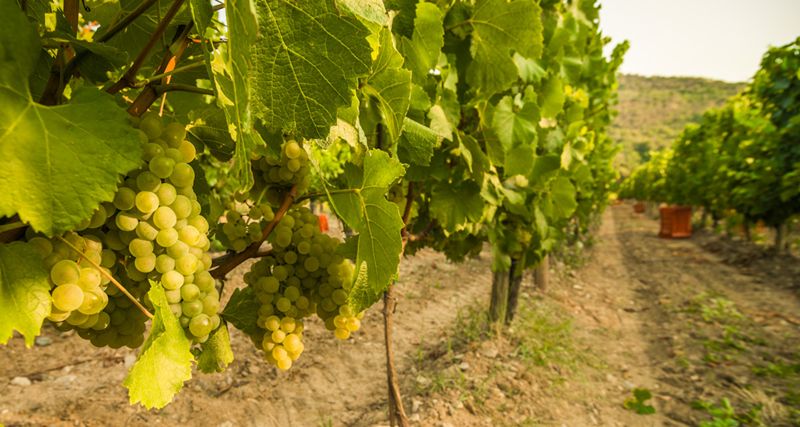
The Valpolicella wine region in northeastern Italy has already moved into the main phase of its 2026 harvest, about two weeks earlier than its historical average, as summer heat and drought pushed ripening forward across the denomination.
In the 19 municipalities covered by the appellation, growers have already started picking Corvina, according to the Valpolicella Wines Consortium. Harvesting of Corvinone and Rondinella is expected to begin next week. The consortium said the current timetable is also 7 days earlier than last year, making Valpolicella one of the major Italian red wine regions to begin harvesting unusually early in a season already marked by record advances in several parts of Europe, including Burgundy, Champagne, Bordeaux and Alto Adige.
At this stage, the consortium said quality expectations are favorable, provided there is no serious adverse weather in the coming weeks. It currently estimates the total harvest at just over 861,000 quintals of grapes, a volume broadly in line with 2025. From this year, however, 172,280 quintals, equal to 20% of production, will be placed into storage under a supply management measure approved by the consortium on April 2.
That measure cuts the yield effectively available to the market from 100 quintals per hectare to 80 quintals per hectare. The stated aim is to protect the economic balance of the supply chain at a time when global demand has weakened. For Amarone and Recioto, the consortium estimates that nearly 328,000 quintals of grapes, or 38% of the total, are being reserved for selection.
Early quality checks carried out by the consortium have so far favored grapes from older vineyards, especially those trained on pergola systems, which it said have handled water stress better. Vineyards supported by adequate irrigation have also shown better results in the first assessments.
Even with those positive vineyard signals, economic concerns are growing. The consortium said grape prices are falling, especially for fruit intended for drying, the key step used in the production of Amarone and Recioto. Christian Marchesini, president of the Valpolicella Wines Consortium, said the drop does not reflect the positions discussed at a supply-chain meeting called by the consortium ahead of the harvest.
Marchesini said growers have already supported policies to reduce yields and accepted the new storage rules designed to protect the denomination’s balance. Further weakening grape values, he said, would hurt the same producers who are helping stabilize the region in a season already shaped by shortages of skilled labor, rising costs, especially energy costs, and a market that remains difficult.
The developments in Valpolicella come as other leading Italian red wine areas prepare for a harvest that is moving at different speeds depending on the region and the grape variety.
In the Langhe, home to Barolo and Barbaresco, Nebbiolo harvesting has not yet started. Sergio Germano, president of the local consortium, said the region is running 5 to 10 days ahead of normal, but growers are still waiting for full phenolic ripeness. Barring surprises, he said, harvest should begin between mid- and late September. He added that vineyards have not suffered significant stress thanks to accumulated water reserves, while recent rainfall has cooled temperatures. Nighttime temperature swings, which Nebbiolo responds to well, are also supporting expectations for a good evolution in the vineyard.
In Tuscany, the picture is mixed. In Bolgheri, some producers have already started picking Merlot and Syrah, according to Daniele Parri, director of the Bolgheri and Bolgheri Sassicaia Wines Consortium. Cabernet Sauvignon, he said, will need a few more days, weather permitting.
In Chianti Classico, the consortium said some early varieties have already been cut, but growers are still waiting to see how conditions develop before starting on the Sangiovese that will become the area’s flagship wine. A similar pattern is taking shape in Montalcino, where some grapes not destined for Brunello di Montalcino have already been harvested. For the Sangiovese that will go into Brunello, harvest is expected to begin in about 10 days. Giacomo Bartolommei, president of the Brunello di Montalcino consortium, said in comments reported by local media that he expects a lower yield in wine, but very high quality.
Farther south, in Abruzzo, the harvest is still focused on early white grapes. Alessandro Nicodemi, president of the Abruzzo Wines Consortium, said growers are currently working on varieties such as Pecorino and Trebbiano. He said drought is being felt in the region and is also expected to affect Montepulciano d’Abruzzo, with harvesting of that red grape likely to begin around mid-September.
On Mount Etna in Sicily, red grape harvesting is still some time away. Francesco Cambria, president of the Etna DOC Wines Consortium, said producers expect to start with white grapes around mid-September and then move to reds from late September into early October, in what he described as a more or less normal timeframe for the area.