Why do some spirits flare up when you bring a lighter near them, while others do not?
The key is not some supposed “strength” of the drink, but how ethanol vapours, composition and temperature come together.

Views › 449
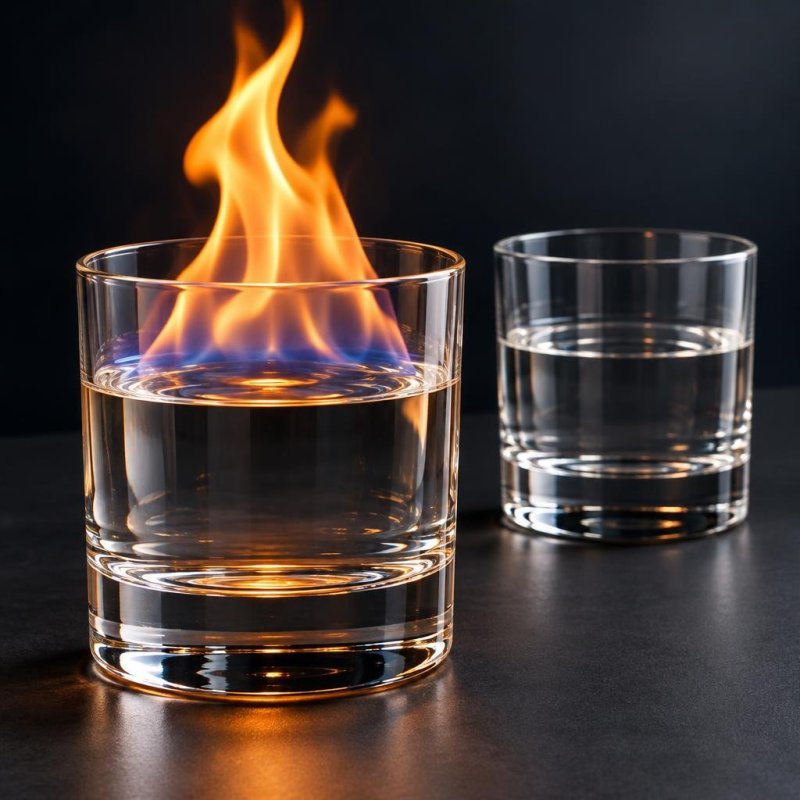
The difference is not some mysterious “strength” in the drink, but what is happening just above its surface. Some drinks can show a flame in certain conditions because ethanol gives off vapours that mix with air. Others, even if they contain alcohol, do not form that flammable mixture in the same way.
The answer is just above the surface
The short answer is that it is not simply “the liquid” catching fire because it contains alcohol. What can burn is ethanol vapour mixed with the air above the drink. Ethanol is the alcohol found in alcoholic beverages. For a flame to appear, several things have to happen at once: there must be enough vapour, that vapour must be mixed with air in the right proportion, and there must be an ignition source. If one of those conditions is missing, you may see no flame at all even though the drink does contain ethanol.
That helps clear up a very common misunderstanding: bringing fire near a drink does not reveal a simple, automatic property. The lighter or outside flame only provides ignition. The drink itself must be releasing flammable vapours at that moment and under those conditions. That is why it makes little sense to assume all spirits behave the same way, or that a quick visual check is enough to understand what a drink contains.
Key idea
When a flame appears, it feeds on ethanol vapours mixed with air above the surface.
Alcohol alone is not enough: mixing with air and an ignition source matter too.
Alcohol strength matters, but it does not explain everything
Alcohol strength, expressed as alcohol by volume, shows what share of the drink is ethanol. That is useful as a guide, because in comparable ethanol-water mixtures a higher proportion of ethanol usually makes ignition easier, while more water usually makes it harder. But the number on the label is not a promise that a flame will appear if fire is brought near it: it tells you about composition, not about a guaranteed result in every situation.
Water is not a minor detail. In the mixtures studied, as its proportion increases, the flash point rises, meaning it becomes harder for the liquid to produce vapours that can ignite. That helps explain why it is not enough to say “it contains alcohol”. Two drinks may both contain ethanol and still behave differently if the ethanol-to-water ratio changes or if the formulation includes other components. That is one reason there is no universal cut-off such as “above this percentage it always burns, below it never does”.
Sweet liqueurs call for another correction. Sweetness on its own does not let you predict whether a drink will show a flame. The studies cited on mixtures of ethanol, water and sugar also do not support the idea that sugar always makes ignition harder. In the formulations tested, flash point fell as sugar increased. Even so, that does not justify quick rules about every commercial liqueur, or broad assumptions about creams, emulsions or flavoured blends.
Temperature changes the outcome too
Another key idea is flash point. This is the lowest temperature at which, under defined test conditions, a liquid gives off vapours that can ignite when they meet an ignition source. It is not the temperature of the flame, and it does not mean the liquid will catch fire by itself. It helps explain why the chance of seeing a flame depends not only on what the label says, but also on the drink’s temperature at that moment.
That leads to an important point for any consumer: the same drink does not have to behave the same way under different temperature conditions. That is also why “room temperature” is not the same thing everywhere or in every setting. Temperature affects how much vapour forms above the surface, and that difference can change the outcome. You do not need exact figures or practical targets to understand this; it is enough to know that temperature is part of the explanation.
A brief flare does not mean sustained burning
Seeing a flame for a moment does not mean the drink will keep burning. The material reviewed distinguishes between the point at which vapours can ignite and the ability to sustain combustion. The two are related, but they are not the same. A brief ignition can happen and then stop. That is why a momentary flame should not be described as if it proved the drink “burns” in a stable, lasting way.
Water matters here again because it does more than dilute ethanol. It also absorbs heat as it warms up and as it evaporates, and that affects the mixture’s heat balance. On top of that, with less ethanol available per unit of volume, combustion also releases less heat. Put simply, a short-lived flame can appear without there being enough energy to keep it going afterwards. This explanation is supported for the mixtures studied and should not be turned into an exact prediction for any particular glass or bottle.
| Situation | What it may indicate | What it does not prove |
|---|---|---|
| A brief flare appears | That ethanol vapours mixed with air were able to ignite at that moment. | That the drink will keep burning in a sustained way. |
| No flame appears | That under those conditions, not enough flammable mixture formed above the surface. | That the drink contains no ethanol. |
Fire does not measure alcohol or certify a drink
Using fire as a test for alcohol leads to mistakes. Alcohol content is measured with specific analytical methods; it cannot be worked out by watching whether a flame appears. Because the outcome depends on several variables, this kind of informal observation cannot tell you the exact alcohol strength. Nor does it mean that a drink that does not ignite contains no ethanol. It may contain ethanol and still fail, at that moment, to form enough flammable vapour mixed with air to show a flame.
It also cannot certify quality, purity, authenticity or the absence of contaminants. If a drink does ignite, all that shows is that, under those conditions, there were vapours capable of burning. It does not tell you whether the product is better, “stronger”, purer or safer. And the absence of a flame does not make a drink harmless around fire either. The mistake to avoid is turning a striking visual effect into a reliable check.
Understanding it does not require trying it
The useful part of this explanation is not to experiment, but to avoid unnecessary risk. Published clinical cases describe burns linked to flaming drinks, and flame travelling back towards the bottle has also been documented when alcohol is added to a drink that is still burning. Alcohol flames can also be hard to see. That is why testing a drink with fire is a bad idea, flames should be kept away from bottles, and alcohol should never be poured onto an existing flame.
If you want to understand why some spirits seem to burn and others do not, the most reliable clue is not a visual trick but three factors working together: ethanol vapours above the surface, the drink’s composition and its temperature. Alcohol strength helps as a guide, but it does not decide the outcome on its own. Sweetness does not either. And a flame, when it appears, is no substitute for a measurement or a sign of quality.
Basic precautions
- Do not test a drink with fire.
- Keep flames away from bottles.
- Do not add alcohol to an existing flame.