Does an expensive wine taste underwhelming? Check its temperature before you judge it
A costly bottle can seem muted because of expectations or the way it is served. Before judging it, check the temperature and see how it changes in the glass.

Views › 1777
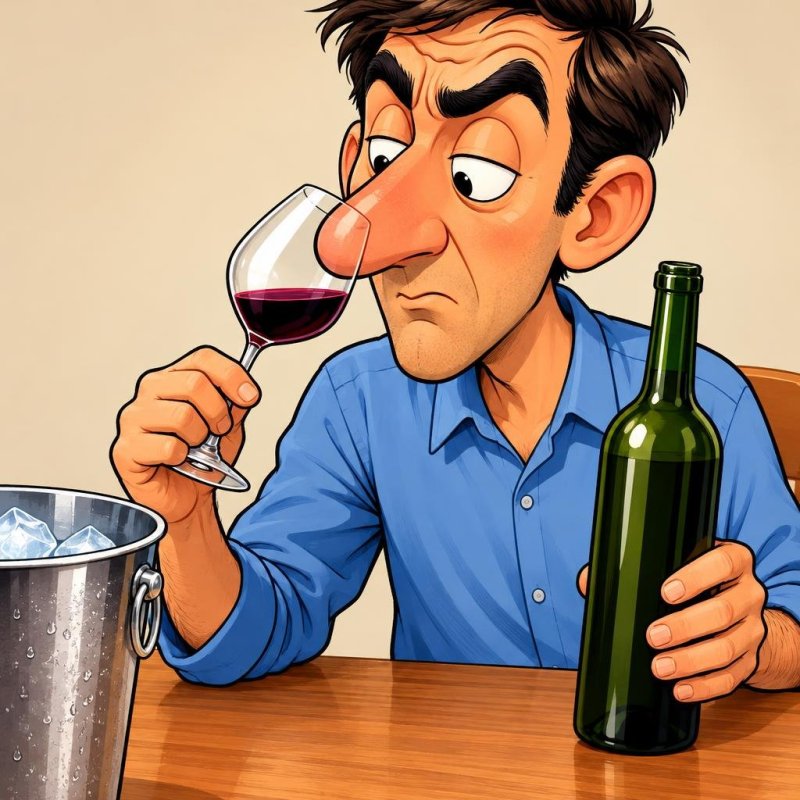
Paying more for a bottle does not guarantee you will enjoy it more, and disappointment does not mean there is some hidden trick nobody told you. Before deciding a wine is weak, watery or dull, it is worth checking something simple: how it is being served and whether the temperature suits it.
Does an expensive wine taste underwhelming? It does not mean you are missing a secret
It happens: you open an expensive bottle, pour a glass, and the first impression feels underpowered. It may seem to have very little aroma, to move across the palate without leaving much of a trace, or simply to offer less than you expected for the price. That reaction is real, but it does not prove the wine literally “tastes like water” or that there is one essential technique someone forgot to tell you.
There is no real basis for saying sommeliers keep these recommendations hidden, either. Serving temperature, aeration and decanting are all part of public training materials and professional wine education. The useful idea is not to hunt for a secret, but to check first whether the wine is being served in conditions that let it show itself more clearly.
Price and pleasure do not always rise together. In a large set of blind tastings, participants without wine training did not, on average, enjoy more expensive wines more. The sample involved volunteers in the United States and was not representative of consumers worldwide. That does not mean all wines are the same or that cheaper bottles are “better,” but it does help separate the actual bottle from the expectation created by its price.
Expectation can also shape how we judge what we drink. Another experiment found that presenting the same wine with different prices changed how much people said they liked it. That alone does not explain any one disappointment, but it does underline something important: part of the experience comes from context, not just from the liquid in the glass.
The useful idea is not to look for a secret
A disappointing expensive bottle does not prove it “tastes like water” or that there is one hidden essential technique.
Before jumping to conclusions, it is worth checking how it is being served, starting with temperature.
What you may be noticing when you say it “tastes like water”
When someone says a wine “tastes like water,” they may be describing different things. Perhaps the aroma is faint when they lift the glass, perhaps the flavour seems muted when they drink it, or perhaps the wine feels light, with less weight on the palate than expected. Those are not quite the same, and separating them helps you decide whether it is worth changing anything before judging the bottle.
A large part of what we casually call flavour comes from the aromas we perceive while drinking. That is why a wine can seem muted not only because of what happens on the tongue, but also because of what reaches the nose, both before and during the sip. More aroma does not automatically mean more quality or more pleasure, but very limited aromatic expression can make the whole wine feel less interesting.
This is where temperature deserves attention, because it can change that expression. Cooling reduces the release of volatile compounds, which help create aroma. Sensory studies have found that temperature affects how different wine attributes are perceived. That does not prove cold is the main reason behind every disappointing bottle, or that it affects expensive wines more than others, but it is a good reason to check because it can noticeably shape what you perceive.
Professional guidance broadly agrees on one point: too much cold can mute the expression of many wines, while a wine served too warm can lose freshness and definition. With reds, too much cold can also make the wine seem thinner and more astringent on the palate. It is not an absolute rule, but it is a practical clue that is easy to check at home.
Two sensations worth separating
Very little aroma or low intensity
That can make a wine seem muted.
Temperature can affect what you notice both on the nose and on the palate.
Light on the palate
This describes less weight or volume, not a flaw in itself.
It is not the same as noticing very little aroma.
Taste it, adjust the temperature, then compare again
A simple first check does not require technical knowledge or special equipment. Pour a small amount, look at the wine, smell it and taste it before changing anything. The question is not whether you should like it because of the price, but what exactly you notice right now: very little aroma, low intensity, too much warmth, too much chill, or a lightness you were not expecting.
If it seems excessively cold and not very expressive, wait a little and taste it again. There is no need for aggressive warming or for a universal waiting time, because a small pour changes faster than a full bottle and every room is different. The idea is simple: let it warm naturally and see whether more detail appears and whether the wine becomes more enjoyable to you.
If, on the other hand, the wine feels too warm for its style, cool it down and compare again. A practical way to do this at home is to place the bottle in ice water so the cold surrounds it more evenly. Then smell and taste it again. The aim is not only to chase more aroma, but to see whether the wine feels better defined, more balanced or simply more pleasing to you.
As a flexible guide, WSET training suggests serving sparkling wines at around 6-10°C, 43-50°F; light- to medium-bodied whites and rosés at about 7-10°C, 45-50°F; fuller-bodied whites at about 10-13°C, 50-55°F; light-bodied reds at around 13°C, 55°F; and medium- to full-bodied reds at 15-18°C, 59-64°F. Here, body means the sense of weight or volume the wine has on the palate. These are useful reference points, not commands.
It is best not to turn those numbers into an obsession. Other professional schools use slightly different ranges, and room temperature is not the same everywhere or in every season. That is why “serve at room temperature” says very little as a general instruction. The most useful practical choice is still to compare before and after, then keep the version that seems more enjoyable to you.
A simple at-home check before deciding
- Pour a small sample, look at it, smell it and taste it without changing anything first.
- If it seems too cold and not very expressive, wait and compare again.
- If it is too warm for its style, chill the bottle with ice and water, then repeat.
- Keep the version that feels more defined or more enjoyable to you, not just the one that smells stronger.
Should you let it breathe? Not just because it was expensive
After temperature, another question usually follows: should you let the wine “breathe”? Aerating means increasing its contact with air. Decanting means pouring it into another container, which can be done either to aerate it or to separate sediment. They are not perfect synonyms, and neither becomes necessary simply because the bottle cost more.
The most sensible approach is to watch how the wine develops in the glass first. Some wines change with a few minutes of air and need no decanter or ritual at all. That approach means less intervention and lets you see whether the wine opens up on its own before you do anything more forceful.
Decanting can make sense in some cases, but not as an automatic reflex and not for a fixed length of time. Heavy aeration may be a poor choice for older or delicate wines. Price alone does not tell you how much air a bottle needs, and buying extra equipment is not required for a basic check at home.
| Action | What it does | What not to assume |
|---|---|---|
| Aerate | Increases the wine’s contact with air, even in the glass. | It is not necessary because of the price, and not for a fixed amount of time. |
| Decant | Pours the wine into another container and can also help separate sediment. | It is not essential equipment, and it is not always a good idea for old or delicate wines. |
If you still do not like it, you do not have to justify the price
Adjusting the temperature or giving the wine a little time to evolve does not oblige you to enjoy it. These checks only let you assess it under different conditions. Sometimes you get more aroma, better balance or clearer definition; sometimes the change is small or does not improve the experience. None of those outcomes means you were drinking it “wrong” before.
It also helps to separate expression from preference. A wine can show itself more clearly and still not be your kind of wine. That does not invalidate your judgment or mean you have to keep drinking it to justify what it cost. The research on price and expectation points in exactly that direction: paying more does not guarantee greater personal enjoyment.
Likewise, if a bottle still seems uninteresting to you, that does not automatically prove it is faulty or spoiled. Without examining that specific wine, you cannot be certain whether the issue is style, service, personal taste or some other problem. The sensible use of these checks is to judge the glass in front of you more fairly, not to force yourself to find pleasure where there is none.