How many calories are in alcoholic drinks? Alcohol, sugar and serving size
The same drink category can vary a lot: alcohol adds energy even with no sugar, and total kcal depend on the recipe and how many millilitres are served.
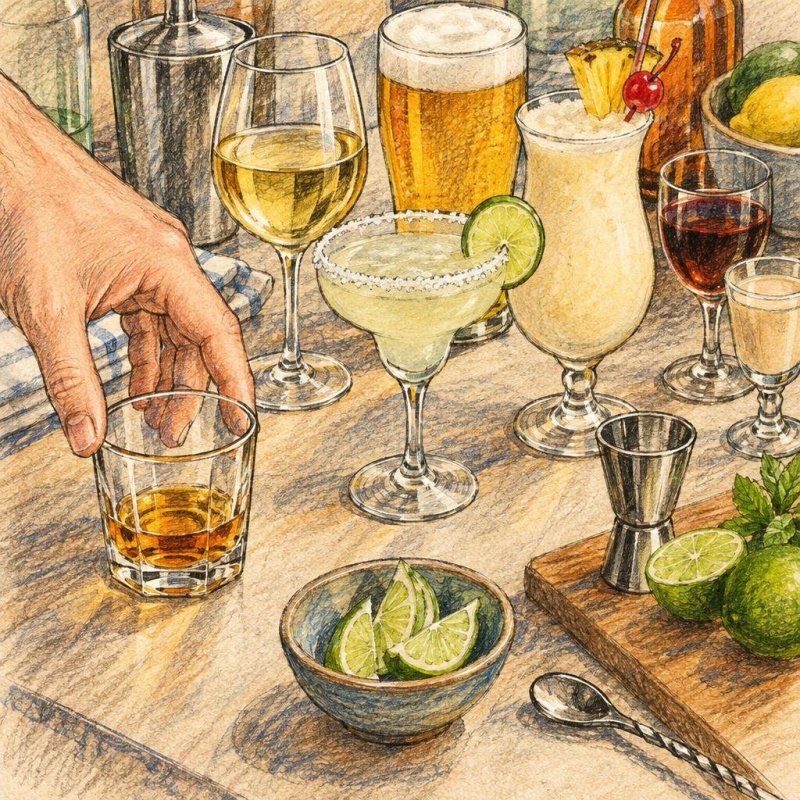
The calories in an alcoholic drink do not depend only on whether it tastes sweet or has a high ABV. The amount poured and the other ingredients in the recipe matter too, which is why a small measure of a stronger drink can provide less energy than a larger serving of a less alcoholic one.
Calories depend on what is in the glass and how much is poured
To compare alcoholic drinks properly, it helps to look at reference servings with their millilitres clearly shown rather than assume there is a universal measure. Usual amounts vary from one country, venue and household to another, so the comparison here focuses on easy-to-read equivalent examples: how much liquid is in the glass and how many kilocalories, or kcal, that approximate amount provides.
That detail changes the picture quite a lot. A spirit can have a much higher ABV than a beer, but if it is served in a much smaller amount it will not necessarily provide more kcal in that serving. In the same way, a cocktail can end up much higher in energy not only because of the alcohol, but also because of the final volume and added ingredients such as sugars, juices or creamy components.
Alcohol adds calories too, even when there is no sugar
The energy in these drinks mainly comes from three sources. Alcohol provides about 7 kcal per gram; carbohydrates, including sugars, about 4 kcal per gram; and fats about 9 kcal per gram. That is why a drink can have little or no declared sugar and still provide a fair amount of calories if it contains alcohol. In some creamy preparations, fat adds extra energy as well.
It also helps not to count the same thing twice. Sugars are part of carbohydrates, so they should not be added separately if you are already using total carbohydrates. And knowing only one isolated figure is not enough to rebuild the full energy value of a drink: knowing the ABV helps, and knowing the sugar helps too, but an exact figure depends on the full composition or on published nutrition information.
A higher ABV does not always mean more alcohol in the serving
ABV expresses the concentration of alcohol by volume. As a rough guide, you may find examples such as beer at 5%, wine at 12%, fortified wine around 17%, some aperitifs or liqueurs around 24%, and spirits at 40%. Among those examples, beer is the least concentrated and spirits the most concentrated, but they are only examples: they do not set the limits of each category or describe every product on the market.
What matters is the difference between concentration and the amount contained in the serving. A simple calculation makes it clear: 150 ml of wine at 12% contains 18 ml of alcohol, and 45 ml of spirit at 40% also contains 18 ml. That does not turn either measure into a serving rule; it simply shows why a higher-ABV drink does not always mean more total alcohol if the amount poured is smaller.
Two different questions that often get mixed up
What does the ABV indicate?
The concentration of alcohol in the liquid: 5%, 12% or 40% do not by themselves tell you how many kcal are in a serving.
How much alcohol is in the serving?
It depends on the ABV and the ml served.
150 ml at 12% and 45 ml at 40% both contain 18 ml of alcohol.
Which drinks have more or less sugar
Here too, one rule does not fit all. Dry wines contain little residual sugar, the sugar left after fermentation, while sweet wines contain more, with amounts that vary by style. Sweetened liqueurs include added sugar, unlike formulations with no declared sugar. Serving a drink on its own does not mean it contains no sugar. In cocktails, sugar may come from the mixer, the juice, the syrup or several ingredients at once. If volume and alcohol stay the same, adding sugar raises the energy value, but that idea should not be turned into a rigid ranking of entire drink families.
As traceable examples, the consulted Heineken Original sheet declares 0 g of sugars and 3.2 g of carbohydrates per 100 ml. That shows that little or no declared sugar does not mean an absence of other carbohydrates or of calories. It is also a figure for one specific formulation: it does not justify saying that all beer has 0 g of sugar, something other beer research also advises against oversimplifying.
In the case of wine, an official table for dry white wine at 12% lists 0.6 g of sugars per 100 g. It is a useful example for understanding why a dry wine can contain a small amount of sugar without being a sweet wine. The unit matters: that figure is published per 100 g and should not be turned automatically into per 100 ml to force exact comparisons the source does not provide.
Lowering the alcohol does not, by itself, settle the question of sugar or total kcal either. The same Heineken sheet lists 42 kcal per 100 ml and 0 g of sugar for Original, versus 21 kcal and 1.3 g of sugar per 100 ml for 0.0. That comparison applies only to those two formulations, but it helps show that less alcohol may reduce part of the energy without necessarily meaning less declared sugar.
Calories per reference serving: keep the millilitres in view
These figures are approximate and comparative. They do not describe a typical worldwide serving, but reference servings taken from composition databases, published examples and specific recipes. Generic values keep the original rounding; for table wine, the 125 kcal for 150 ml come from a proportional calculation based on 123 kcal in about 148 ml and should not be attributed to all dry or sweet wines. The generic references and recipes come from the report of the US dietary guidelines scientific committee; the fortified wine and cream liqueur examples come from the NHS.
Drink or preparation Type of reference Volume Approx. energy Regular beer Generic 355 ml 153 kcal Table wine Generic; proportional calculation 150 ml 125 kcal Fortified wine at 17.5% Reference formulation 75 ml 102 kcal 40% spirit, no mixers Generic 45 ml About 100 kcal Cream liqueur at 17% Reference formulation 50 ml 153 kcal Reference margarita Recipe 118 ml 168 kcal Reference piña colada Recipe 266 ml 495 kcal
The comparison makes several points clear. Among these references, the lower-energy servings are the 45 ml spirit and the 75 ml fortified wine, both around 100 kcal. At the upper end is the 266 ml piña colada at about 495 kcal. There is no need to overstate tiny gaps between rounded figures, but it is worth noticing which factors keep recurring: more volume, more total alcohol or more energy-dense ingredients.
| Drink or preparation | Volume | Approx. energy |
|---|---|---|
| Regular beer | 355 ml | 153 kcal |
| Table wine | 150 ml | 125 kcal |
| 40% spirit, no mixers | 45 ml | About 100 kcal |
| Cream liqueur at 17% | 50 ml | 153 kcal |
| Reference piña colada | 266 ml | 495 kcal |
How size and ingredients change the result
One of the most useful contrasts is this: 45 ml of spirit at 40% can provide less energy than 150 ml of table wine, even though the first drink has a higher ABV. The result depends on volume and composition, not on strength alone. When two servings contain the same amount of alcohol, they provide the same energy from ethanol; the calorie difference then comes from their other components. That comparison breaks the idea that the stronger drink is always the more caloric one when you look at the amount actually served.
Another striking contrast is the cream liqueur. In this selection, 50 ml of cream liqueur at 17% comes out at roughly the same 153 kcal as 355 ml of regular beer. That does not mean the two categories always match, only that a small serving can pack a lot of energy when alcohol is combined with sugar and fatty or creamy ingredients.
The reference piña colada shows the role of the recipe especially well. Its energy does not depend only on the rum, but also on the cream of coconut, the pineapple juice and the final size of the drink. That is why a cocktail can sit far above a drink served on its own. Even so, that figure should not be treated as a fixed truth for every piña colada or for every named cocktail.
How to calculate the kcal in the amount you are served
If a bottle, technical sheet or database gives kcal per 100 ml, adjusting the amount is simple: kcal in the serving = kcal per 100 ml × ml served ÷ 100. That calculation works when the original information is expressed by volume and the drink keeps the same formulation. It is the most practical way to move from a label figure to the amount actually in the glass.
For a mixed drink, the method changes: you need to add up the energy of each ingredient according to the amount used. If the composition is unknown, only an approximation is possible. If sugar data are missing, that should not be read as 0 g. Looking only at the ABV or only at the sugar can help, but it cannot replace a full figure. Before comparing, it is worth checking three things: the volume served, the alcohol percentage and any nutrition information available for that specific formulation.
Three checks before you compare a specific drink
- Volume served: compare the actual ml, not just the category.
- ABV: % vol shows alcohol concentration, not kcal by itself.
- Nutrition information or recipe: if there are figures per 100 ml, scale them to the serving; if it is a mixed drink, add the energy of its ingredients.